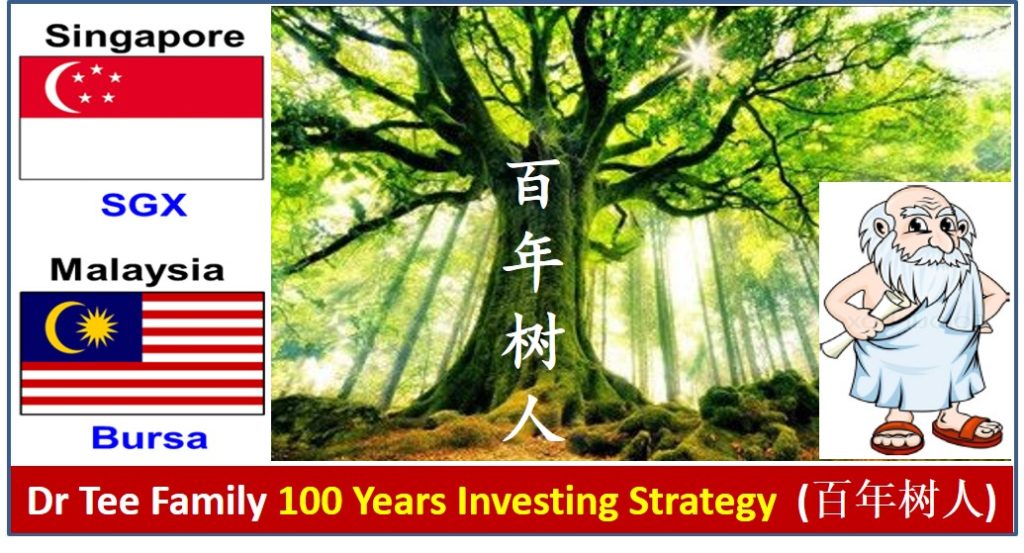
Dr Tee Family 100 Years Investing Strategy (百年树人)

Parents are our best role models for life including investing. Dr Tee will share in this article, both valuable life principles learned from his father (who passed away recently) and also a lifetime investing strategy with 100% success rate practiced by his parents, applicable in both stock and property markets.

Bonus is Dr Tee Grandparents Crisis Investing Strategy for reader who could patiently read the entire article. This investing strategy is proven over 3 generations of Dr Tee family over the past 100 years.

Many people hope to learn a “sure-win” investing strategy. For most practical considerations, there is a certain probability of success for each stock trading or investing strategy but rarely could achieve 100% success rate.

Dr Tee parents have a remarkable achievement to have 100% winning record in both stock and property investment consistently over the past few decades. This lifetime investing strategy may not be suitable for everyone, requiring alignment of similar personality as Dr Tee parents. Let’s learn the details here.

Some people may change mind easily, even for a good investment (stock or property), if the market prices fall down significantly, some may end up sell low with losses under tremendous fear. Alternatively, some people could hold an investment for long term, even over a lifetime but due to declining businesses, suffering permanent losses over time.

Dr Tee parents’ “Sure-Win” Strategy is simple but only if one could align with similar personality (work hard + take right investment action). Here are the 3 main steps:

1) What to Invest

For stock investment, Dr Tee parents prefer giant stocks from country stock index component, especially those with strong business fundamental stocks with good track record (both capital gains and dividend payout) over the past decades. 

Property (house or land with high quality asset) by default is a giant, therefore also a key option for their investment. Their main source of investment knowledge was through reading local newspaper investment articles and discussion with friends having similar interest.

This “100% winning” strategy requires support of a portfolio of giant stocks (reviewing giant stocks status yearly for possible change in business fundamental). Many giant stocks could be found in a country stock index. For example, these are 30 STI component stocks, could be a possible starting point for lifetime investing for an investor in Singapore:

DBS Bank (SGX: D05), Singtel (SGX: Z74), OCBC Bank (SGX: O39), UOB Bank (SGX: U11), Wilmar International (SGX: F34), Jardine Matheson Holdings JMH (SGX: J36), Jardine Strategic Holdings JSH (SGX: J37), Thai Beverage (SGX: Y92), CapitaLand (SGX: C31), Ascendas Reit (SGX: A17U), Singapore Airlines (SGX: C6L), ST Engineering (SGX: S63), Keppel Corp (SGX: BN4), Singapore Exchange (SGX: S68), Hongkong Land (SGX: H78), Genting Singapore (SGX: G13), Mapletree Logistics Trust (SGX: M44U), Jardine Cycle & Carriage (SGX: C07), Mapletree Industrial Trust (SGX: ME8U), City Development (SGX: C09), CapitaLand Mall Trust (SGX: C38U), CapitaLand Commercial Trust (SGX: C61U), Mapletree Commercial Trust (SGX: N2IU), Dairy Farm International (SGX: D01), UOL (SGX: U14), Venture Corporation (SGX: V03), YZJ Shipbldg SGD (SGX: BS6), Sembcorp Industries (SGX: U96), SATS (SGX: S58), ComfortDelGro (SGX: C52).

For different country, an investor may start with local stock indices with component stocks, eg. 30 KLCI stocks, 50 HSI stocks, 30 Dow Jones stocks, S&P 500 stocks, 50 SSEC stocks, Top 10 largest NASDAQ stocks, etc.  Subsequently, analyze business fundamental and other critical criteria for giant stocks. Here is a list of 30 Malaysia Bursa KLCI Index component stocks which may be considered for Malaysia stock investors:

CIMB (Bursa: 1023) CIMB GROUP HOLDINGS BERHAD, DIALOG (Bursa: 7277) DIALOG GROUP BERHAD, DIGI (Bursa: 6947) DIGI.COM BERHAD, GENM (Bursa: 4715) GENTING MALAYSIA BERHAD, GENTING (Bursa: 3182) GENTING BERHAD, HAPSENG (Bursa: 3034) HAP SENG CONSOLIDATED BERHAD, HARTA (Bursa: 5168) HARTALEGA HOLDINGS BERHAD, HLBANK (Bursa: 5819) HONG LEONG BANK BERHAD, HLFG (Bursa: 1082) HONG LEONG FINANCIAL GROUP BERHAD, IHH (Bursa: 5225) IHH HEALTHCARE BERHAD, IOICORP (1961) IOI CORPORATION BERHAD, KLCC (Bursa: 5235SS) KLCC PROPERTY HOLDINGS BERHAD, KLK (Bursa: 2445) KUALA LUMPUR KEPONG BERHAD, MAXIS (Bursa: 6012) MAXIS BERHAD, MAYBANK (Bursa: 1155) MALAYAN BANKING BERHAD, MISC (Bursa: 3816) MISC BERHAD, NESTLE (Bursa: 4707) NESTLE MALAYSIA BERHAD, PBBANK (Bursa: 1295) PUBLIC BANK BERHAD, PCHEM (Bursa: 5183) PETRONAS CHEMICALS GROUP BERHAD, PETDAG (Bursa: 5681) PETRONAS DAGANGAN BHD, PETGAS (Bursa: 6033) PETRONAS GAS BERHAD, PMETAL (Bursa: 8869) PRESS METAL ALUMINIUM HOLDINGS BERHAD, PPB (Bursa: 4065) PPB GROUP BERHAD, RHBBANK (Bursa: 1066) RHB BANK BERHAD, SIME (Bursa: 4197) SIME DARBY BERHAD, SIMEPLT (Bursa: 5285) SIME DARBY PLANTATION BERHAD, TENAGA (Bursa: 5347) TENAGA NASIONAL BHD, TM (Bursa: 4863) TELEKOM MALAYSIA BERHAD, TOPGLOV (Bursa: 7113) TOP GLOVE CORPORATION BHD.

2) When to Invest

Dr Tee parents only have middle-class income from active jobs, which salary in cash would depreciate over time. When they got married about 60 years ago in Muar (a small town in Johor of Malaysia), both were having little starting capital. Since young, over 4 decades of working hard, they would gradually convert the cash saving into another form of “fixed deposit” through purchases of stocks (both private and public listed companies) and properties (houses and plantations), which could generate passive incomes (eg. stock dividends and property rentals, much higher than bank interest rates) and consistent growth with enormous capital gains. 

Besides regular conversion of cash into saving (spending very little on themselves, saving every dollar possible for family with 4 children), later into stocks or properties, Dr Tee parents would invest more during financial crisis, especially when they observed the stock index (eg. KLCI Index as they live in Malaysia) was at relatively low level or when there was special sales of house or land below the market prices.

Dr Tee parents worked very hard (like a habit) for whole life, even after they have retired, could not rest well for 1 day, must find something to do each day in kampung.  To them, this is their ideal lifestyle to keep busy (but not stressful) each day. Dr Tee wished they could be more relaxed but looking back now, this could be blessing in disguise as some retirees who relaxed too much, may age even faster.

3) When to Sell

Most of the time, Dr Tee parents would not sell stocks or properties, keeping them long term over lifetime, collecting both passive incomes (which can be used for family expenses or reinvest again) and capital gains. Sometimes when stock index or investment is at high optimism level, they would sell but most of the time, they would simply ignore them, keeping as “fixed deposit” which could compound each year for decades through stocks and properties. Apply this simple method of investing (buy stocks as if property for many generations to stay) on giant stocks, naturally the success rate is 100% over the decades, overcoming all the stock “crisis” eventually.

In a certain period of time for about 10 years, due to high cost to support 4 children (Dr Tee and 3 siblings) university education in US (ringgit was weak vs USD), they decided to sell significant private shares of palm oil plantation (with many times of capital gains). This was rare for them to sell properties or stocks to convert back into cash but children (especially education) are their most important goal in life. They strongly believe that knowledge is the best investment to generate more wealth (eg. with a better job) to support a better future life.

Dr Tee parents were working very hard, saving almost every dollar they could during this period, spending very little on themselves, saving and then investing mainly to provide additional financial shield for children. History seems to repeat itself, it is turn for Dr Tee to do similar planning for family with children. However, Dr Tee could still have reasonable spending (disagree with parents who almost did not spent much on themselves) as children should also work hard to enjoy fruits of life with own creation of wealth.  This way, the “shield” contributed by each generation could be compounded to protect against a major future crisis.  If not, wealth could not last through 3 generations with spending alone. 

Financial literacy could be the best gift for any young generation. Dr Tee is amazed that a few Ein55 graduates are as young as 14 years old (learning together with parents), could understand and apply value investing principles. With compounding return of many decades to come, knowing what giant stocks to invest, these young learners main goals would be to work hard and save more for capital to start the first investment of life one day. 

This “Buy Low and Hold” strategy for long term or even lifetime suit Dr Tee parents personalities.  Some people may not have patience to hold or wish to sell earlier for capital gains to enjoy life, therefore missing the natural compounding growth of giant stock or property, hedging against inflation.  To maximize the compounding over lifetime, one has to start investment younger. Assuming 50 years of lifetime investing (eg. 30 to 80 years old) with average of 10% growth rate, capital gains could be as high as 1.1^50 = 117 times.  Even with a minimal 5% growth rate over 20 years (eg. 40 to 60 years old when retiring), capital gains could be 1.05^20 = 2.65 times.

So, this “sure-win” strategy could be very simple (tested over 100 years with 3 generations) but could be very tough as some people may not able to make sacrifice in life (eg. not willing to invest in oneself to enhance knowledge in own profession or investment), simply wait for gift to drop from heaven (most of the time are speculative news, ending up with big losses).  So, heaven is fair, usually reward those who work hard and follow the right path of investing, even if one forgets about making money one day (eg. Buy Stocks / Properties and Forget), hidden fortune would appear naturally one day when needed.

So, the secrets of making money in investment is not to think of making money, just do the right proven actions, eg: investing over a portfolio of 10-20 giant stocks, buying more during financial crisis, holding long term, then the compounded return would come naturally one day.

My Father Story

Similar to investment, life also has its own cycle. My father (Mr Tee Ching Sin, 郑清森) passed away peacefully recently due to natural aging.  Over the past 10 years, this has been my biggest worry to receive unexpected call from parents in Malaysia which could be potential sad news.  The day still comes with expected call when I was halfway conducting a Zoom coaching class, need to hold my tears to complete the program as this is a commitment, a value shared by my father.

When I observed my parents have been getting older each year, I started to slow down the pace of my work or interest in investment education (used to work 365 days a year, 7 days a week, working nearly all the time), visiting them more often in Malaysia over the past few years. Each time when I said farewell to them when returning to Singapore, I was thinking could this be the last time we meet in life.

More importantly, my father has taught me many positive values in life (not just making money with investment), setting an excellent example with his whole life. Despite he has left the world, sometimes I could still “hear” his voices which is embedded in the subconscious mind (similar to Artificial Intelligence, AI). This is how a “spirit” or family value could be transmitted between the generations.

Similarly, I often use “Dr Tee” as third person narration when teaching investment knowledge to students or writing articles (eg. Dr Tee aims for “giant stocks”, investing when giant is falling during crisis, etc), hopefully this could help to form positive habits of investment in a faster way with AI into their minds when they hear “Dr Tee voices” in their subconscious mind one day.

This article is a special tribute to my father, a short summary of his successful life, not only with “sure-win” investing strategy and hardwork over lifetime, but also for his selflessness to think of family first.  It is a regret that there is travelling restriction to Malaysia during pandemic (requires 14 days quarantine), together with 2 other siblings living outside Malaysia, we join the online ceremony to pay the last respect to our father.

My father dedicated his whole life for family but reward little to himself. During his funeral ceremony today, I have shared my feeling remotely in Chinese (you may use google translator if needed) to him:

爸爸,您是我们心目中,敬重的父亲。

您的3个孩子,姐姐,二哥和我,身在海外,因为疫情的情况下,国家限制旅游,不能回来尽孝,我们庆幸过去与您保持密切联系,亲情永在,不限一时。

爸,身为您的儿女与亲友们,舍不得与您告别。

纵然您已离开尘世,浩瀚宇宙中遨游,您不朽的精神,将永远留在我们心里。

爸爸,多谢您一生无私的付出,栽培了我们四个孩子,海外留学,开阔视野。教育是您留给我们最珍贵的资产,我们也继承了您的精神与理念,与后代分享。

年轻时,为了给家庭增强经济后盾,您毅然放下教鞭,从事繁重的经商活动,过度劳累,透支身心。晚年时,纵然行动不便,您意志顽强,坚持独立活动,心灵手巧,甚至到人生最后一刻。

言传不如身教,您是我们的人生楷模。我们从中观察,学习宽容待人,刻苦节俭,不畏失败,活出自我。孩儿东渊记得,曾经问您为何不多花一分钱在自己身上,却慷慨帮助孩子们与他人。您说人生已无遗憾,家人安康就是最大的满足。

爸爸,请您放心,我们会照顾好妈妈。 您的一生是成功的, 无憾无悔,不枉此生。我们衷心感激您为家庭的无偿付出。

爸爸,愿您一路走好,我们爱您,永远怀念您。

Suddenly, I remember this old song by Taiwanese singer (高凌風 – 牽不住你的手, “Could Not Hold Your Hands”), now finally I could understand the meaning as he wrote this song when losing his father many years ago: https://www.youtube.com/watch?v=xQmQllux1bo

I was hoping to hold my father hands for the last time. I tried to appeal to Malaysia High Commission in Singapore by queuing up before 8am (hope to enter Malaysia without quarantine if pass COVID test in 1-2 days) but standard answer was to fill in online form (which has no option of funeral, mainly ask to sign to agree to pay for 14 days quarantine in hotel after entry to Malaysia with on-site test) and wait for reply which response time is not guaranteed. I sadly called ICA of Singapore for help (hoping there is some special agreement between 2 countries on travelling for special case of funeral, not just on businesses), standard answer is entry to Malaysia depends on Malaysia policy. So, the recent bi-lateral “Reciprocal Green Lane” may not have considered hundreds of thousands of citizens with close elderly family members in both countries (Singapore and Malaysia were 1 country before, hard to separate families apart with a political border).  COVID-19 crisis is not only a health and financial crisis, may also be a family crisis.

I am relieved that online technology (Whatsapp Group Video) has helped to lessen this potential biggest regret in my life. My siblings and I who are abroad Malaysia could follow entire funeral ceremony remotely in an interactive way, praying and talking to my father who rest peacefully, knowing all his children would get united again regardless of obstacles. Except I could not hold my father hands anymore.

I remember a unique subject studied in university time in US several decades ago: “On Death & Dying”. The funeral services are not just for the deceased, also for those who are alive to heal their wounds in heart. It is a way to accept and adjust to new norm in life without the loved one (switching connection from physical to spiritual).

Looking back, I believe my father may have special plan in choice of timing to depart us (knowing that I would try different ways to get there to see him for the last time). Perhaps this was his intention not to trouble 3 of children abroad, not to take any risk in travelling. If so, I may need to thank the authority with hard rules for helping my father to achieve his final wish to help family again.

Father, please Rest in Peace. The best way to repay your kindness in lifelong support is to maximize values of my own life which I promise won’t disappoint you!

Dr Tee’s Grandparents Story

In fact, Dr Tee parents also learned from their parents who have similar personality of working hard, despite low income but knowing how to invest to improve on quality of life. Dr Tee grandparents were very poor (not having any formal education, could only do lower income work) when first came from China to Malaysia nearly 100 years ago.

After many years of working and saving little by little, Dr Tee grandparents grabbed the rare opportunity of Japanese occupation time (1940s) to use life saving in “banana money” to buy a small piece of land with rubber plantations at very low price (a form of crisis investing during World War II), holding for 80 years till today with about 2000 times capital gains. 

Many people lose money in saving cash when Japanese “banana money” became zero value overnight but Dr Tee grandparents converted the cash (paper value) into land (high quality asset), therefore reversing the family poverty destiny, converting crisis into opportunity.  With the first foundation (plantation could generate incomes), they continue to improve family financial condition with more purchases of land with hard earned savings (but similar crisis of low land price was only once a lifetime).

Dr Tee grandparents success (hardwork with special help of crisis investing in property) has changed the future of Tee family (from poor to middle class). This inspired Dr Tee parents to follow similar track of working hard and invest when young (but extending from properties to stocks).  Crisis investing of high quality assets at low price is a high probability of winning if one has holding power.

Similarly, the success of last 2 generations has motivated Dr Tee to study hard (aiming for highest educational level of PhD), then work hard to achieve the career goals (climbing ladder till VP in corporate world, then CEO of own company after becoming financial free) and extending investment from long term investing to short term trading, developing an universal way of “Buy Low Sell High” with Ein55 styles of investing for stocks, properties, bonds, commodities and forex.

Dr Tee owes the current success (both personal life and investment) to contribution of 3 generations of Tee family over the past 100 years.  The same principles of life (work hard with simple life) are not just passed to 4th generation but also shared with over 3000 Dr Tee graduates and over 300,000 public audience over the past 10 years.

Even if you not Tee family member, could you duplicate this simple secret of success in life with “Sure-Win” strategy? Answer is yes but not everyone could do it.  A person must be willing to have a determination of working hard (or study hard in early age) for life, spending little on oneself, converting saving into higher growth investment with a portfolio of giant stocks or properties, investing more during financial crisis time, then holding for high growth over lifetime.

If you could read every word of this article until this here, you have the potential to be the first generation of your family to inspire future generations for another 100 years (百年树人)!

=================================================

Drop by Dr Tee free 4hr webinar (learning at comfort of home with Zoom) to learn how to position in global giant stocks during COVID-19 stock crisis with 10 unique stock investing strategies, knowing What to Buy, When to Buy/Sell.

Zoom will be started 30 min before event, bonus talk (Q&A on any investment topics from readers) for early birds. There are many topics we will cover in this 4hr webinar, Dr Tee can have more time for Q&A if you could stay later after the webinar.

Dr Tee will cover over 20 case studies, Singapore giant stocks, eg. CapitaLand Mall Trust (SGX: C38U), Singapore Exchange (SGX: S68), Keppel Corp (SGX: BN4), Top Glove (SGX: BVA), Jardine Matheson Holdings JMH (SGX: J36), Vicom (SGX: WJP) and many others, Malaysia giant stocks, Hong Kong giant stocks and US giant stocks, both long term investing and short term trading.

There are limited tickets left for this 4hr free webinar, please ensure 100% you could join when register: www.ein55.com
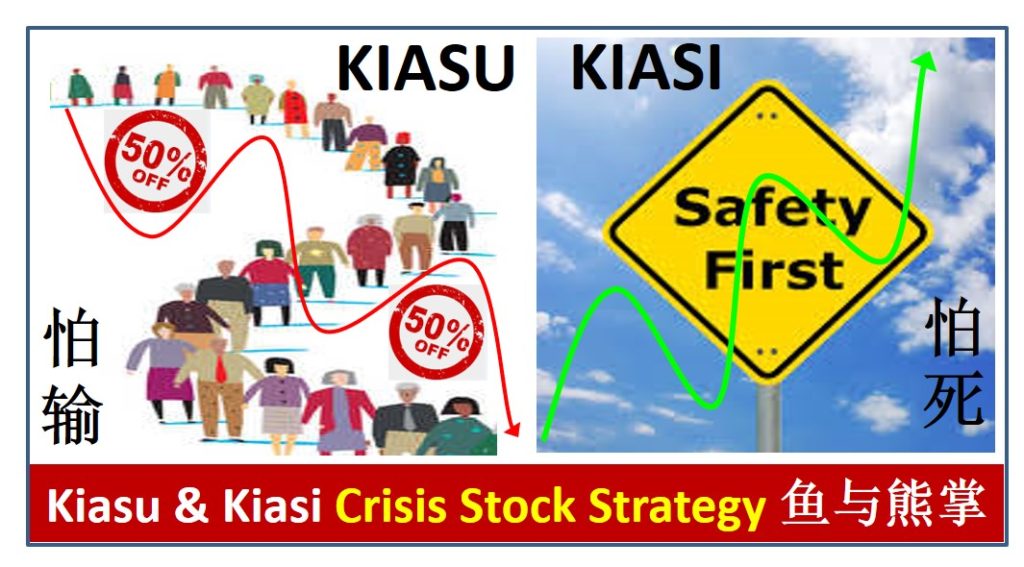
Kiasu & Kiasi Crisis Stock Strategy (鱼与熊掌)

Kiasu Kiasi Crisis Stock Strategy

There are 2 distinct fearful personalities in each person (depending on condition): Kiasu (怕输) and Kiasi (怕死). Kiasu is “Fear of Missing Out” (FOMO), eg. commonly seen in Great Singapore Sales (long queue overnight for certain special offer), afraid of missing the opportunity. Kiasi means “Fear of Death”, safety first in most actions with low risk. Of course, it is possible to have Kiasu and Kiasi together, eg. long queue in supermarket, afraid the food supply may be limited during Coronavirus crisis.

It is not a shame to be Kiasu and/or Kiasi as it is human nature. A smart investor may align one’s unique fearful personality with opportunities in global stock market crisis. This way, the inner potential could be fully maximized to profit from giant stocks at low optimism. Let’s study in more details on both crisis stock strategies.

1) Kiasu Crisis Stock Strategy

This is suitable for contrarian investor with counter-trend investing strategy during bearish stock market, especially when stock prices are far below the intrinsic value, dropping below low optimism <25%. Warren Buffett could be the best example of this type of investor, usually show hands when market is crashed, “be greedy when others are fearful”.

Similar to Great Singapore Sales, when a shopper has only $100 budget, seeing a handbag with 50% discount at $50, may buy 1 first due to fear of missing out (Kiasu) as the opportunity may be on available on that day. It is crucial to reserve the capital as there be another better offer elsewhere or another day with 70% discount.

Contrarian investor is similar to smart shopper, would invest in giant stocks with strong business fundamental with multiple entries. For stock capital of $10k, one may split into several investments, eg (10 x 10%) or (5 x 20%) or (2 x 50%), etc, diversifying over different prices, each entry could be X% apart, eg 5-10% lower each time to justify further investment. This way of average down at low optimism prices would help to get as close to bottom price as possible, even no one would know what will be the lowest price.

Assuming the crisis (buy low get lower) may last for 1-2 years, investing with giant dividend stocks (including giant REITs) with overt 5% dividend yield would help to strengthen the holding power as during this period, one could enjoy 5% passive income (assuming worst crisis may even cut 50% of dividend, left only 2.5%, still higher than bank interest rate of 1+%). When crisis is over (no need to time the market), naturally the investor would enjoy the capital gains when stock prices start to soar, supporting by growing business of giant stocks. Then, contrarian investor may need to plan for when to sell or how long to hold (similar to last few years when global stock markets were in high optimism >75%).

Common failure of this strategy by beginner is to buy weak fundamental stocks at “historical low” price or last 10 years low, which may become lower in future, company may go bankrupt during crisis (eg. certain weak airlines or F&B stocks in Coronavirus crisis), may not have chance to wait for share price or business recovery.

For this strategy to work, contrarian investor requires to invest in a portfolio of giant stocks at low optimism (ideally <25%) with strong business fundamental (following Dr Tee criteria, there are over 1500 global giant stocks). If capital is limited, one may invest in major stock index ETF at low optimism (eg. Hong Kong Hang Seng Index ETF, Singapore STI ETF, China SSEC ETF, etc) which indirectly has diversification over a portfolio of blue chip stocks (although not all are giant stocks).

2) Kiasi Crisis Stock Strategy

This is suitable for trend-following investor or traders, waiting for reversal of share prices from bottom (paying premium of higher prices similar to insurance to ensure price is back to uptrend), still buying at low optimism <25% (but in uptrend price direction). This is integration of trading (trend-following) into investing (waiting for price below intrinsic value of giant stocks).

Safety is important for kiasi traders who could not let the capital stuck in the stock market as regular income (capital gains within weeks or months) is important for short term to mid term trading. Therefore, a stronger uptrend over weeks or months need to be established first (reg. higher highs and higher lows price pattern) before entry.

In case the uptrend or reversal could be a technical rebound, a trader needs to do further deeper market analysis to understand the competing forces of greed (eg. unlimited QE, less cases in Coronavirus, etc) and fear (eg. serious Coronavirus condition, weaker economy and business). For risk management, a trader may apply S.E.T. (Stop Loss, Entry, Target Prices) trading plan, following strictly. When direction is correct, a trader may add more position in the same direction (eg. uptrend prices).

For trend-following investors or traders, the risk of stuck in long winter (low optimism period such as global stock crisis, Global Financial Crisis or even Great Depression) is lower than counter-trend investors, therefore possible to consider growth stocks (little dividend) or some midfielder stocks (mix of growth and dividend stocks), focusing more on capital gains in a more bullish stock market.

==========================

There are about 100 global giant dividend stocks (suitable for Kiasu contrarian investors) and 300+ global giant growth stocks (suitable for Kiasi trend-following investors or traders). It is possible for a smart investor to integrate both kiasu and kiasi strategies together, investing with multiple entries in both bearish and when reversal to bullish stock market with growth dividend giant stocks at low optimism, having the best of 2 investing worlds (鱼与熊掌、实可兼得).

==================================

Drop by Dr Tee free 4hr investment course to learn how to position in global giant stocks with 10 unique stock investing strategies, knowing What to Buy, When to Buy/Sell.

Learn further from Dr Tee valuable 7hr Online Course, both English (How to Discover Giant Stocks) and Chinese (价值投资法: 探测强巨股) options, specially for learners who prefer to master stock investment strategies of over 100 global giant stocks at the comfort of home.

You are invited to join Dr Tee private investment forum (educational platform, no commercial is allowed) to learn more investment knowledge, interacting with over 9000 member.

Dr Tee Investment Course (Stock, Property, Commodity, Forex, Bond)

Wait for Durian to Drop in Stock Crisis 榴莲忘返

durian stock crisis

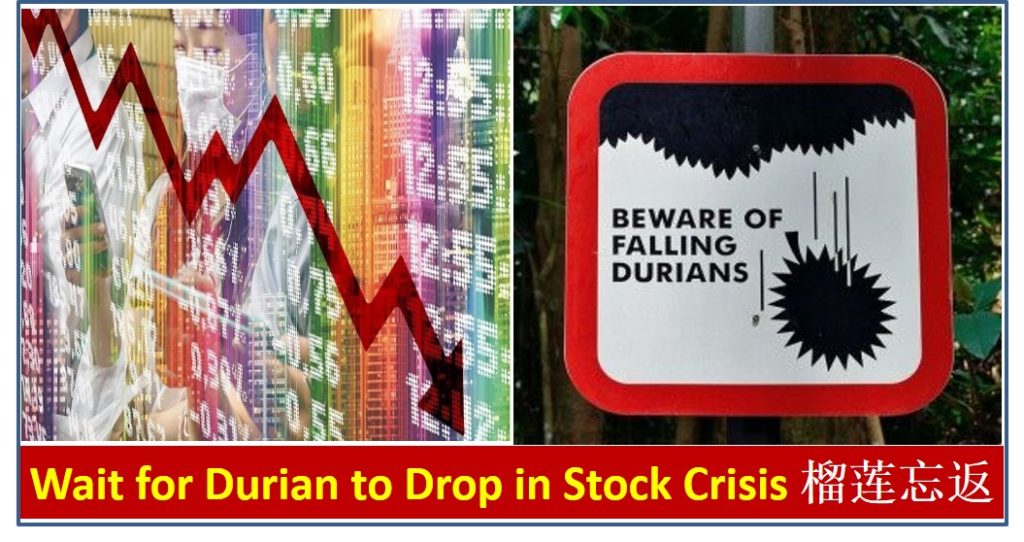
Investing in global stock crisis is similar to wait for durian to fall (best if other people’s durian tree). It is fine to wait for durians to drop, eg. DBS Bank (SGX: D05) below $10/share or giant stocks below low optimism level, but if there is a small durian (eg. DBS below $15/share) comfortable to oneself along the way (so low that everyone could reach), may take one first, no need to wait for the biggest durian in the world as luck may not be there all the time (eg. buying at the lowest price).

This way, at least when the durian waiting game is over (Coronavirus fear), each investor has a gift from heaven for investment during crisis.

DBS Bank (SGX: D05) below $10/share or OCBC Bank (SGX: O39) below $5/share is as if durian drops down, some “abnormal” contrarian investors would start to enter. Every 10+ years, this DBS durian only has chance to drop, currently not ripe yet. Other giant stocks fruits (may not as tasty as durian) start to ripe already, hanging low, waiting for investors to pluck with a low price. But some worry the price of future durians may drop further, so still waiting for lower price. Question is durian may stop to drop one day, no one know when is the day, so need to take calculated risk at certain point, otherwise need to accept possibility of missing the opportunity boat one day.

Usually summer time around Jun-Aug is durian season here, perhaps implying more opportunities then. Coronavirus may end by summer for stock market to recover or pandemic may continue longer to cause global financial crisis. Stock investment is similar to wait for durian, must eventually take action (Buy, Hold, Sell, Wait, Shorting), otherwise one may be still empty handed after the season is over (榴莲忘返).

Cash is king when used at the right time. The key is to define the “right time” for everyone, aligned to own personality.

1) Counter-trend investors (buy low sell high) may start to take action in bearish stock market below low optimism < 25%.

2) Life-time investors (buy low & hold for life time) may want to wait for Level 3-4 (eg US) to fall to low optimism or even until global financial crisis happens (eg GDP declines over 10% in many countries).

3) Trend-follower traders or investors may wait until the durian feast is over, there will be still leftover due to over supply, not in a hurry to join the bearish stock market, wait for the trend to reverse first before long the market. Some traders who could not wait till summer, may want to collect “junk” durian by selling to others (shorting at junk stocks in bear market) to make profit.

Despite many global giant stocks are at low optimism (not yet for DBS), but Levels 3 (country, eg. US) and Level 4 (world) stock market are not yet at low optimism (but trending down again this week), so it is prudent to save silver bullets but need to have a plan to trigger it, so that will get something when stock hunting game is over.

Remember to ensure durian tree will not fall first (business fundamental is strong, won’t go bankrupt easily) during the thunder storm (economic crisis), otherwise no more durian in future, investor may also get injure as buy low for weak fundamental stock may get lower or get zero eventually.

So, which type of durian are you waiting to drop? D24 (DBS) or Mao Shan Wang or any global giant durian?

There are 30 Banking & Finance Stocks in Singapore including DBS Bank (investor has to focus only on giant stocks for investing):
AMTD IB OV (SGX: HKB), B&M Hldg (SGX: CJN), DBS Bank (SGX: D05), Edition (SGX: 5HG), G K Goh (SGX: G41), Global Investment (SGX: B73), Great Eastern (SGX: G07), Hong Leong Finance (SGX: S41), Hotung Investment (SGX: BLS), IFAST Corporation (SGX: AIY), IFS Capital (SGX: I49), Intraco (SGX: I06), Maxi-Cash Finance (SGX: 5UF), MoneyMax Finance (SGX: 5WJ), Net Pacific Finance (SGX: 5QY), OCBC Bank (SGX: O39), Pacific Century (SGX: P15), Prudential USD (SGX: K6S), Singapore Exchange (SGX: S68), SHS (SGX: 566), Sing Investments & Finance (SGX: S35), Singapore Reinsurance (SGX: S49), Singapura Finance (SGX: S23), TIH (SGX: T55), Uni-Asia Group (SGX: CHJ), UOB Bank (SGX: U11), UOB-KAY HIAN HOLDINGS (SGX: U10), UOI (SGX: U13), ValueMax (SGX: T6I), Vibrant Group (SGX: BIP).

==================================

Drop by Dr Tee free 4hr investment course to learn how to position in global giant stocks with 10 unique stock investing strategies, knowing What to Buy, When to Buy/Sell.

Learn further from Dr Tee valuable 7hr Online Course, both English (How to Discover Giant Stocks) and Chinese (价值投资法: 探测强巨股) options, specially for learners who prefer to master stock investment strategies of over 100 global giant stocks at the comfort of home.

You are invited to join Dr Tee private investment forum (educational platform, no commercial is allowed) to learn more investment knowledge, interacting with over 9000 members.

Dr Tee Investment Course (Stock, Property, Commodity, Forex, Bond)

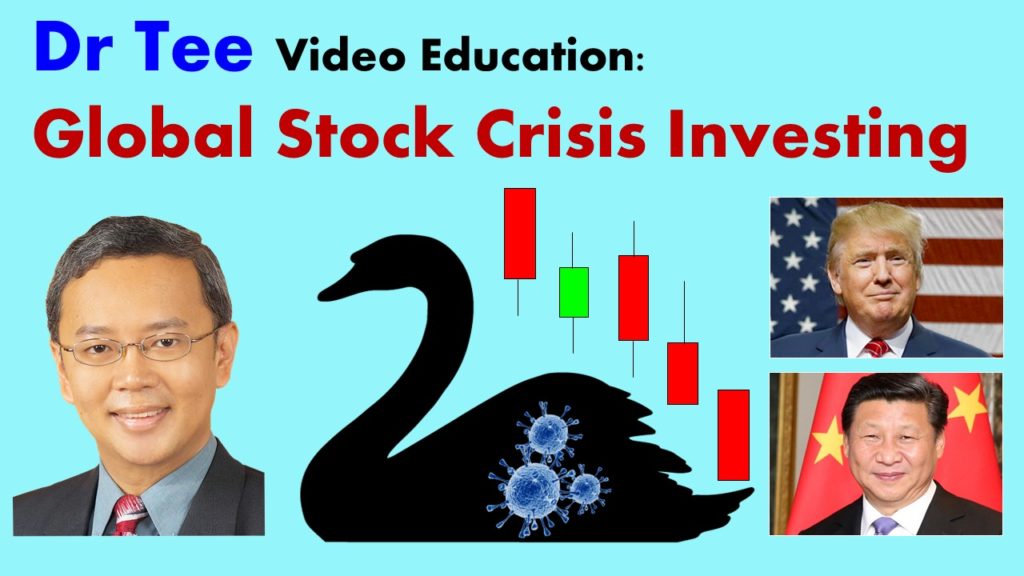
Dr Tee Video Education: Global Stock Crisis Investing

Global Stock Crisis Investing

In this Dr Tee video education (Global Stock Crisis Investing), you will learn:

1) Understand how the 2 black swans crashed the global stock market in last 1 month

2) Compare global stock market losses: US, Singapore, Hong Kong, China, Germany.

3) Technical Analysis of Coronavirus by country with stage of virus life cycle and estimated ending period.

4) Position in two possible scenarios for global stock market before summer 2020 (Jun-July).

5) Investment clock (When to Buy / Sell) with Optimism Strategies (long term / mid term / short term) for 5 global stock markets: World, US, Singapore, Hong Kong and China.

Here is English Version of Ein55 Video Course (Chinese version is available as Dr Tee is bilingual):

This crisis investing strategy may be applied to 30 Singapore STI index component stocks (investor has to focus only on giant stocks for investing):
DBS Bank (SGX: D05), Singtel (SGX: Z74), OCBC Bank (SGX: O39), UOB Bank (SGX: U11), Wilmar International (SGX: F34), Jardine Matheson Holdings JMH (SGX: J36), Jardine Strategic Holdings JSH (SGX: J37), Thai Beverage (SGX: Y92), CapitaLand (SGX: C31), Ascendas Reit (SGX: A17U), Singapore Airlines (SGX: C6L), ST Engineering (SGX: S63), Keppel Corp (SGX: BN4), Singapore Exchange (SGX: S68), Hongkong Land (SGX: H78), Genting Singapore (SGX: G13), Mapletree Logistics Trust (SGX: M44U), Jardine Cycle & Carriage (SGX: C07), Mapletree Industrial Trust (SGX: ME8U), City Development (SGX: C09), CapitaLand Mall Trust (SGX: C38U), CapitaLand Commercial Trust (SGX: C61U), Mapletree Commercial Trust (SGX: N2IU), Dairy Farm International (SGX: D01), UOL (SGX: U14), Venture Corporation (SGX: V03), YZJ Shipbldg SGD (SGX: BS6), Sembcorp Industries (SGX: U96), SATS (SGX: S58), ComfortDelGro (SGX: C52).

This powerful strategy can be extended to global giant stocks including 30 Malaysia Bursa KLCI index component stocks (investor has to focus only on giant stocks for investing):
CIMB (Bursa: 1023) CIMB GROUP HOLDINGS BERHAD, DIALOG (Bursa: 7277) DIALOG GROUP BERHAD, DIGI (Bursa: 6947) DIGI.COM BERHAD, GENM (Bursa: 4715) GENTING MALAYSIA BERHAD, GENTING (Bursa: 3182) GENTING BERHAD, HAPSENG (Bursa: 3034) HAP SENG CONSOLIDATED BERHAD, HARTA (Bursa: 5168) HARTALEGA HOLDINGS BERHAD, HLBANK (Bursa: 5819) HONG LEONG BANK BERHAD, HLFG (Bursa: 1082) HONG LEONG FINANCIAL GROUP BERHAD, IHH (Bursa: 5225) IHH HEALTHCARE BERHAD, IOICORP (1961) IOI CORPORATION BERHAD, KLCC (Bursa: 5235SS) KLCC PROPERTY HOLDINGS BERHAD, KLK (Bursa: 2445) KUALA LUMPUR KEPONG BERHAD, MAXIS (Bursa: 6012) MAXIS BERHAD, MAYBANK (Bursa: 1155) MALAYAN BANKING BERHAD, MISC (Bursa: 3816) MISC BERHAD, NESTLE (Bursa: 4707) NESTLE MALAYSIA BERHAD, PBBANK (Bursa: 1295) PUBLIC BANK BERHAD, PCHEM (Bursa: 5183) PETRONAS CHEMICALS GROUP BERHAD, PETDAG (Bursa: 5681) PETRONAS DAGANGAN BHD, PETGAS (Bursa: 6033) PETRONAS GAS BERHAD, PMETAL (Bursa: 8869) PRESS METAL ALUMINIUM HOLDINGS BERHAD, PPB (Bursa: 4065) PPB GROUP BERHAD, RHBBANK (Bursa: 1066) RHB BANK BERHAD, SIME (Bursa: 4197) SIME DARBY BERHAD, SIMEPLT (Bursa: 5285) SIME DARBY PLANTATION BERHAD, TENAGA (Bursa: 5347) TENAGA NASIONAL BHD, TM (Bursa: 4863) TELEKOM MALAYSIA BERHAD, TOPGLOV (7113) TOP GLOVE CORPORATION BHD.

===================================

There are over 1500 giant stocks in the world based on Dr Tee criteria, choice of 10 Dream Team giant stocks have to align with one’s unique personality, eg. for shorter term trading (eg. momentum or swing trading) or longer term investing (cyclic investing, undervalue investing or growth investing). Readers should not just “copy and paste” any stock (What to Buy, When to Buy/Sell) as successful action taking requires deeper consideration (LOFTP strategies – Level / Optimism / Fundamental / Technical / Personal Analysis) which you could learn further from Dr Tee Free 4-hr Webinar.

Zoom will be started 30 min before event, bonus talk (Q&A on any investment topics from readers) for early birds. There are many topics we will cover in this 4hr webinar, Dr Tee can have more time for Q&A if you could stay later after the webinar.

Dr Tee will cover over 20 case studies, Singapore giant stocks, eg. CapitaLand Mall Trust (SGX: C38U), Singapore Exchange (SGX: S68), Keppel Corp (SGX: BN4), Top Glove (SGX: BVA), Jardine Matheson Holdings JMH (SGX: J36), Vicom (SGX: WJP) and many others, Malaysia giant stocks, Hong Kong giant stocks and US giant stocks, both long term investing and short term trading.

There are limited tickets left for this 4hr free webinar, please ensure 100% you could join when register: www.ein55.com
Crisis Stock Investing – Buy Low Sell High (Not Buy Low Sell Lower)

Crisis Stock Investing
Crisis stock investing is attractive to buy low sell high with potential huge capital gains when share prices recover one day. Here are a few general rules to follow:
 
1) Capital allocation less than 10% (striker position in a portfolio) as the investment is higher risk to exchange for higher potential gains.
 
2) Before Buy Low, ensure the stock is still a giant stock with reasonable fundamental (accepting the facts business could decline over the past few years due to crisis), eg positive earning or cashflow, despite in declining mode.
 
3) Ensure it is a higher level induced crisis, eg. sector correction (L2), country crisis (L3) or global financial crisis (L4). If it is only a business crisis for individual stock (L1) while the competitors are healthy, do not buy low as the company could bankrupt eventually, one could lose all the investment this way. Even a stock is traded at 1 cent per share (previous high could be $1), it is still expensive as it could drop to $0 value or price.
 
For Ein55 graduate, I have posted the details of Ein55 strategies (quantitative) for crisis investing in Ein55 graduate web forum under thread of “investing strategies” – “Crisis Investing Strategies”, specifically on What to Buy & When to Buy.
 
For general public, you could learn more about crisis investing at Levels 1-4 from Dr Tee free course, register here.
Dr Tee Investment Course (Stock, Property, Commodity, Forex, Bond)

Crisis Stock Investing with 4 Qualities of Low Optimism Stocks

crisis stock investing

Crisis stock investing is investing in cyclic giant stocks, ideal for Buy Low Sell High investing strategy.  Usually crisis may happen at business (Level 1, company losing money), sector (Level 2, bearish sector), country (Level 3, recession) or global (Level 4, financial crisis), creating different degrees of fear in the stock market, resulting in fall of share prices.  Subsequently, when the market fear turns into greed, these crisis stocks may become uptrend momentum stocks, ideal for selling high.

There are 4 different qualities of crisis stocks with long term low optimism. An investor has to carefully identify the nature of crisis stock investing, understanding how the falling in share prices are induced.

1) Low Quality Low Optimism (L1 Crisis Stock Investing)

Long term optimism of stock is low, driven by decline in L1 business but L2-L4 are fine.  Noble Group could be an example. Without consideration of sustainable business, pure strategy of Buy Low may result in Get Lower in share prices, which is a common pitfall for Technical Analysis.  Both Fundamental Analysis (FA) and Technical Analysis (TA) should be integrated with Optimism Strategies with consideration of Personal Analysis (PA)

2) Average Quality Low Optimism (L2 Crisis Stock Investing)

Long term optimism of stock is low, driven by decline in L1 business & L2 (sector), while L3-L4 are fine. Examples include oil & gas crisis stocks in the last 1 year, casino crisis stocks 2 years ago, etc.  It happens during the sector rotation which the sector market cycle may not align with the country/global economy cycle.  If the sector is not a sunset industry, usually it would recover again as there is unique demand vs supply within each sector for investment.

3) High Quality Low Optimism (L3/L4 Crisis Stock Investing)

Long term optimism of stock is low, driven by decline in L1-L4 (business/sector/country/global financial crisis). More than 50% global cyclic giant stocks during global financial crisis would be affected in both business (drop in earning or even losing money) and share prices (L1-L4 from individual stock to global stock indices).  Since the market fear at L3/L4 may not last long (global political leaders would take actions by then to save the whole world), the downside of global stock market is limited but an investor needs to have sufficient holding power through the cold winter time of global financial crisis.  For example, many cyclic giant bank stocks may behave this way.

4) Excellent Quality Low Optimism (L4 Crisis Stock Investing with strong L1 Business)

Long term optimism of stock is low, driven by decline in L2-L4 (sector/country/global financial crisis) but L1 business is fine. Less than 10% global growth giant stocks during global financial crisis could still be profitable or even growing in business while the share prices falling relatively less (defensive in nature) than the average in global stock market.  In fact, defensive growth giant stocks are suitable for Buy Low & Hold for long term investing, sell is an optional strategy.

The safest time to buy a giant stock is when everyone is afraid the sky will fall down while the business is still operating normally with consistent performance. This could be a rare opportunity to buy during a crisis but many people are too normal, do not know how to take this advantage to truly buy low sell high.

A smart investor may not need to consider only crisis stock investing.  There are other strategies such as growth stocks, dividend stocks, undervalue stocks and momentum stocks, etc, may be integrated to form a balance stock investment portfolio.

Learn from Dr Tee through high-quality free stock investment courses.

Dr Tee Investment Course (Stock, Property, Commodity, Forex, Bond)