5 Cheung Kong Super Hong Kong Stocks (长江一号)

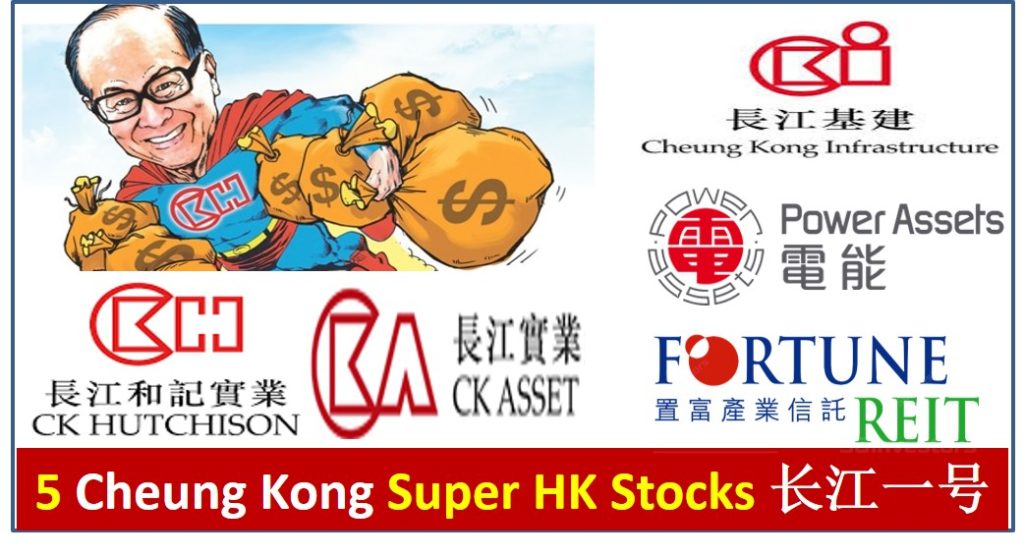
Cheung Kong Stock CKH CKI CKA Power Assets Fortune Reit HKEx HPH Trust

Sir Li Ka-Shing (李嘉诚) is the richest person in Hong Kong for decades, earning a nickname of “Superman Li” for his reputation in the business world. He was born in 1928 in Chao Zhou (潮州) of China (Dr Tee visited there several years ago, Li Ka-Shing donated a lot of money to his hometown), therefore 92 years old so far. Technically he has retired but mentally never stop working for 1 day, still an advisor to his children and his beloved Cheung Kong Holdings.

Cheung Kong Group is famous initially as a property company, then expanding over the decades, becoming a multinational conglomerate with diversified businesses. CK parent stock is assigned #1 stock ticker in HKEx stock exchange (长江一号), showing its strength as a Hong Kong blue chip giant stock. In Year 2015, there is a major restructuring of Cheung Kong, merging with Hutchison Whampoa, forming a new company Cheung Kong Holdings (registered in Bermuda, could be due to long term planning) with 2 main companies with 2 stocks:

CK Hutchison (CKH) – (HKEx: 1) – For non-property related business

CK Assets (CKA) – (HKEx: 1113) – For proper related business

This way, it is clearer to investors on choices of investment based on these 2 divisions. However, the reorganization has affected the long term analysis of Cheung Kong as there are significant relocation of assets between 2 divisions of companies.  Therefore, it is a born of 2 “new” companies with 5 years of history in integrated business reporting but share price of CKH is much longer due to its extension of former parent stock, providing additional references on share prices.  It is important for a smart investor to analyze each segment of business for both CK companies before making decision of which stock to invest.

In fact, CK Holdings have at least 11 stocks listed within the group (only 5 highlighted ones are giant stocks):

1) CK Hutchison (CKH) – (HKEx: 1) – CK Parent Giant Stock (Non-property Division)

2) CK Infrastructure (CKI) – (HKEx: 1038) – Utility Parent Giant Stock

3) Power Assets (PA) – (HKEx: 6) – Utility Subsidiary Giant Stock

4) CK Life Sciences – (HKEx: 775) – Biotechnology Stock

5) Tom Group – (HKEx: 2383) – Chinese language media stock

6) HPH Trust – (SGX: P7VU) – Port Trust Stock

7) Husky Energy – (TSE: HSE) – Energy stock listed in Canada

8) CK Assets (CKA) – (HKEx: 1113) – CK Parent Giant Stock (Property Division)

9) Fortune Reit – (HKEx: 778) – CK Giant Reit

10) Hui Xian REIT – (HKEx: 87001) – CK Reit

11) Prosperity REIT – (HKEx: 808) – CK Reit

Out of 10 CK stocks, there are 4 giant stocks included in 50 Hang Seng Index component stocks: CKH, CKA, CKI and PA.  So, technically Superman Li could move Hong Kong stock market (about 4%).  This is similar to “rival” Jardine Group, could move Singapore Straits Times Index (about 15%) with 5 component stocks. In 1980s, Li Ka-shing was aiming to “invest” more in Hongkong Land of Jardine Group but was defeated by cross-shareholding structure of Jardine (another long story, read Dr Tee earlier article on Jardine Group of 7 giant stocks).

Not all the 10 CK stocks are strong based on Dr Tee giant stock criteria. There is only 1 more giant CK subsidiary stock, Fortune Reit is a giant Reit (formerly dual listing, after delisting from SGX, now only listed in HKEx).

So, additional comments will be given below on these 5 giant CK stocks from different businesses. An investor may select either the parent group (CKH or CKA) if want to consider average of entire group business (non-property vs property) as if a fund, or focusing on smaller individual stock of subsidiaries (CKI, PA, Fortune Reit) on specific business segment.

1) CK Hutchison (CKH) – (HKEx: 1) – CK Parent Giant Stock (Non-property Division)

CK Hutchison has 5 main business segments in non-property division. Investing in CKH stock means investing in all business segments.

1.1) Port

The port businesses are relatively stable in the past but Coronavirus crisis in Year 2020 would affect the results for Year 2020. HPH trust (not a giant stock with limited business potential) is only a small part of CK port business.

1.2) Retail

Major business is Watson for health and beauty (15794 stores with 12 brands worldwide). Business growth in China and Asia are faster than in western world. This is consumer related business, therefore Coronavirus would seriously affect the business for a few quarters. Temasek is also a shareholder for Watson, was planning to sell it.

1.3) Infrastructure / Utilities

This is main passive income generator for CKH. More details later under discussions of subsidiary giant stocks CK Infrastructure and Power Assets.

1.4) Telecommunication

This segment of business is growing in general, having mixed performance in different countries. It is a more defensive business.

1.5) Energy / Investment / Others

Energy segment is making losses while other remaining business is less significant to contributing to entire group.

CKH business (non-property) is not as defensive as CKA (property), therefore over the past 5 years since the group reorganization, share price has been dropping to nearly to 1/3 from peak of $120 to $45. Despite the Price to Book (PB) ratio is 0.5 but the asset is non-property, not as high quality.  The main investing advantage for CKH is low optimism level < 25%, aligning to global stock crisis (following economic cycles) but it could suffer in business during Coronavirus crisis due to global lockdown.

Dividend yield of 5.7% is attractive but investors may need to prepare for potential 50% cut as the worst case scenario (despite CKH has good track record of consistent dividend payment) during the winter time of CKH business, implying 3% yield which is still better than holding cash with 1% interest for cash deposit in bank.  CKH has significant business in Europe, when economy is restarted, CKH quarterly business performance would improve gradually.

2) CK Infrastructure (CKI) – (HKEx: 1038) – Utility Parent Giant Stock

3) Power Assets (PA) – (HKEx: 6) – Utility Subsidiary Giant Stock

Both CKI and PA stocks may be studied together as CKH owns CKI, then CKI owns PA, all inter-related, just different ways of grouping. So, an investor may decide investing in parent company or subsidiary business specifically in utilities.

CKI has many global businesses of infrastructures and utilities (electricity, water, gas), holding strategic asset of certain countries and cities (eg. main electricity supplier of London). Power Assets invests mainly in electricity, eg. providing partial electricity supply to Hong Kong, duopoly with another giant electricity stock, China Light and Power, CLP (HKEx: 2). Readers may guess if CKH could get HKEx stock ticker #1, CLP could get stock ticker #2, implying it is another blue chip stock with proven history (if there is a chance, we may share further on CLP or other monopoly stocks in future).

Utilities business are defensive as people may not need to shop during Coronavirus pandemic or global financial crisis but they still need basic usages of electricity, water and gas. So, utilities or infrastructure related stocks usually show their strength during economic crisis as defensive stocks which could still pay dividend with steady cash flow generated, then gradual capital gains in longer term with recovery and subsequent growth of economy.

In general, both CKI and PA are having close performance in stocks, prices have dropped by half over the past 5 years (more defensive than parent stock CKH which dropped to nearly 1/3 from the peak price), dividend payment has been stable due to defensive industry, current dividend yield is over 5%.  The main “risk” of both stocks is bearish price trend over the past few years (despite at lower optimism level, buy low may still get lower in prices), not so much on business risks (minimal), therefore investors who are reluctant to catch the falling knife in prices, may wait for uptrend in prices, sacrificing passive income (dividend yield) with higher price to exchange for confirmation in price reversal to bullish range.

4) CK Assets (CKA) – (HKEx: 1113) – CK Parent Giant Stock (Property Division)

CK Assets are property-based businesses, listed as a new stock, therefore only having 5 years of share price history so far which are more defensive than CKH (dropping to 1/3), but price is cyclic in nature, dropping to half price. Price to Book (PB) ratio is also coming to a new low of 0.5, having 50% safety margin for high quality asset of property. 

However, Hong Kong property market (about 20 years for 1 market cycle) has been at high optimism after the average prices gone up by 4 times over the past 2 decades. Therefore, property stocks in Hong Kong in longer term, may suffer “loss” in valuation due to lower property prices if there are any crisis related to China or Hong Kong property bubble.  CKA at current price is 50% discount but “rival” property stock, Hongkong Land has 75% discount with PB around 0.25. So, after relative comparison with peers, CKA 50% discount in price may not be excellent.  In fact, there are many other property giant stocks in Hong Kong which are “cheap and good”, readers may learn from Dr Tee to explore more in future.

5) Fortune Reit – (HKEx: 778) – CK Giant Reit

There are 3 REITs listed from CKA parent group: Prosperity Reit and Hui Xian Reit are relatively weaker, so we focus only in Fortune Reit.  Previously, Fortune Reit has dual listing in both HKEx and SGX but now only left HKEx. There is little difference to Singapore investors as there is no capital gain tax nor dividend withholding tax for Hong Kong stocks, except HKD/SGD is currently at high optimism (HKD is pegged to USD, similar trend for USD/SGD), future potential forex loss (when USD or HKD is depreciated vs SGD) could be compensated by dividend and capital gains of Hong Kong or US stock.

Fortune Reit drops over 40% in share price over the past 2 months of global stock crisis, resulting in high dividend yield of 7.4% with consistent dividend payout of its REIT portfolio. Risks of Coronavirus is minimized as China / Hong Kong conditions are much better than the rest of the world. Social unrest (eg. Hong Kong protesters last year) is also a lower risk now. The REIT is protected by Price-to-Book (PB) ratio of 0.4, rare for a strong REIT with 60% discount, implying under the worst case scenario, even if the company goes bankrupt, investors could still get back the capital (unlike other investors would suffer permanent loss buying stocks with low quality assets).  Usually PB is not a strong criteria for REIT, consistent rental collection from tenants is more important which Fortune Reit has a good track record. The REIT manager is also another familiar name: ARA Asset Management, used to be a giant stock with good reputation in Singapore but delisted several years ago (not surprise as this company is too good to share in long term with the public).

In short, investing in Fortune Reit could receive the protection from sponsor, CK Group, in addition to 60% safety margin in share price to property asset value. REIT (rental payment) could be more predictable than property-based business (eg. parent company CKA) which may suffer when property value declines. For a reit, even property value may decline, rental won’t fall as much, especially if located in strategic places with higher populations.

================================

If you could read until this line, it means that you are a serious investor as Dr Tee has spend half a day to write this article, you only need less than 30 min to read but need a few more days to digest to align the right CK stocks (1 of the 5 giant stocks) to your own personality. Each of the 5 CK giant stocks has its own pros and cons, may not be suitable for everyone. Overall, they all are at low optimism < 25%, implying higher potential for longer term investors. Their main “risks” may not be on business (Coronavirus could affect for Year 2020 but may not for long term), but more on bearish stock price trends since the group reorganization in 2015 till now. Global investors still try to find a sweet spot of balance between price and value for the “new” CK group of stocks.

Cheung Kong has been blue chip stocks for decades in Hong Kong, paying consistent dividend despite bearish stock prices or fluctuation in businesses. The main intangible “asset” of CK Group could be Li Ka-Shing, a trusted icon of CK for decades. Despite Mr Li has retired, he has transferred his business and investment knowledge to his 2 sons, Victor Li (taking over his empire of CK business) and Richard Li (inheriting most of his cash to start own business beyond CK Group). This way, 2 “tigers” won’t be in same jungle (only 1 main decision maker), smart move by a father with far vision to minimize potential family conflicts in the same business.

So, if readers may not have the same wisdom as Li Ka-Shing on investing, we may leverage on him through investing in CK group of giant stocks at lower optimism prices. Li family are unlikely to sell their stocks, therefore they would work day and night for you to grow the business as they are major shareholders (interest is aligned). Better still, readers may contribute no effort except just capital for investment at the right price (ability to press the button when seeing the signal with strategy aligning to own personality), Li family could then work for you for another generation until Victor Li may retire one day as well or passing to the third generation. Of course, you may then sell the stocks for capital gains one day or transfer the stock to your own second generation to keep.

If readers worry Li Ka-Shing may go bankrupt during global financial crisis (he went through at least 9 times over his 92 years of life experience), then smart investor may look for Top 10 richest persons in the world (Li Ka-Shing is only the 30th richest in the world), investing in their best stocks with stronger business than CK Group, forming a portfolio of Top 10 richest person’s giant stocks as a dream team portfolio.  Of course, you may not get a good discount in share prices when their businesses are very strong now, therefore stock “crisis” is usually a good opportunity to own some of these giant stocks with growing businesses.

Li Ka-shing stocks are stronger than many 50 Hang Seng HSI index component stocks or 30 STI index component stocks (investor has to focus only on giant stocks for investing):
DBS Bank (SGX: D05), Singtel (SGX: Z74), OCBC Bank (SGX: O39), UOB Bank (SGX: U11), Wilmar International (SGX: F34), Jardine Matheson Holdings JMH (SGX: J36), Jardine Strategic Holdings JSH (SGX: J37), Thai Beverage (SGX: Y92), CapitaLand (SGX: C31), Ascendas Reit (SGX: A17U), Singapore Airlines (SGX: C6L), ST Engineering (SGX: S63), Keppel Corp (SGX: BN4), Singapore Exchange (SGX: S68), Hongkong Land (SGX: H78), Genting Singapore (SGX: G13), Mapletree Logistics Trust (SGX: M44U), Jardine Cycle & Carriage (SGX: C07), Mapletree Industrial Trust (SGX: ME8U), City Development (SGX: C09), CapitaLand Mall Trust (SGX: C38U), CapitaLand Commercial Trust (SGX: C61U), Mapletree Commercial Trust (SGX: N2IU), Dairy Farm International (SGX: D01), UOL (SGX: U14), Venture Corporation (SGX: V03), YZJ Shipbldg SGD (SGX: BS6), Sembcorp Industries (SGX: U96), SATS (SGX: S58), ComfortDelGro (SGX: C52).

==================================
Are you interested to invest in giant stocks of Warren Buffett, Bill Gates and Jeff Bezos? Learn from Dr Tee Free 4hr investment course to master how to take advantage of global giant stocks and funds, know What to Buy, When to Buy / Sell. Leverage on investment education to grow your wealth in a safer way.

Learn further from Dr Tee valuable 7hr Online Course, both English (How to Discover Giant Stocks) and Chinese (价值投资法: 探测强巨股) options, specially for learners who prefer to master stock investment strategies of over 100 global giant stocks at the comfort of home.

You are invited to join Dr Tee private investment forum (educational platform, no commercial is allowed) to learn more investment knowledge, interacting with over 9000 member.

Dr Tee Investment Course (Stock, Property, Commodity, Forex, Bond)

Kiasu & Kiasi Crisis Stock Strategy (鱼与熊掌)

Kiasu Kiasi Crisis Stock Strategy

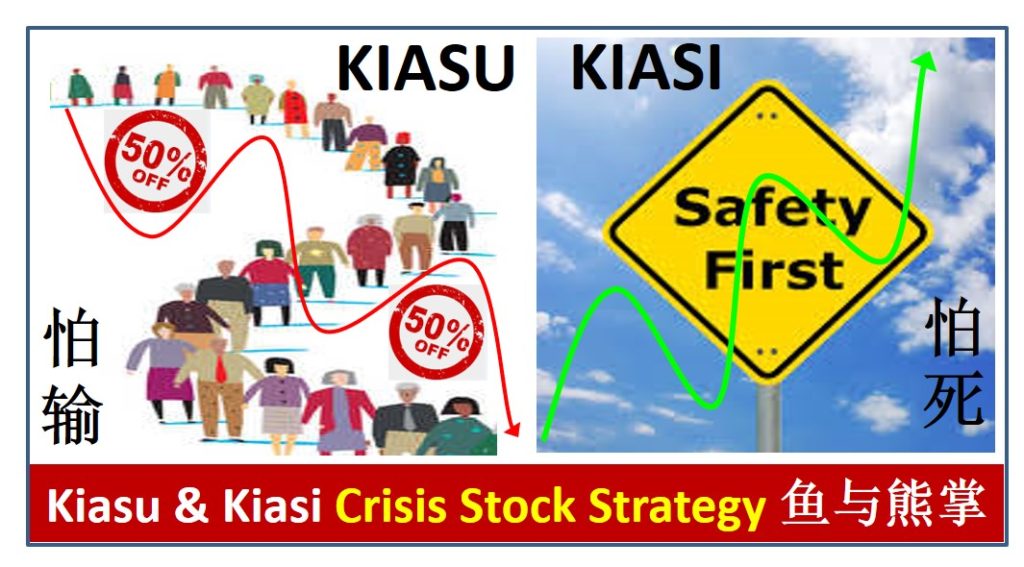
There are 2 distinct fearful personalities in each person (depending on condition): Kiasu (怕输) and Kiasi (怕死). Kiasu is “Fear of Missing Out” (FOMO), eg. commonly seen in Great Singapore Sales (long queue overnight for certain special offer), afraid of missing the opportunity. Kiasi means “Fear of Death”, safety first in most actions with low risk. Of course, it is possible to have Kiasu and Kiasi together, eg. long queue in supermarket, afraid the food supply may be limited during Coronavirus crisis.

It is not a shame to be Kiasu and/or Kiasi as it is human nature. A smart investor may align one’s unique fearful personality with opportunities in global stock market crisis. This way, the inner potential could be fully maximized to profit from giant stocks at low optimism. Let’s study in more details on both crisis stock strategies.

1) Kiasu Crisis Stock Strategy

This is suitable for contrarian investor with counter-trend investing strategy during bearish stock market, especially when stock prices are far below the intrinsic value, dropping below low optimism <25%. Warren Buffett could be the best example of this type of investor, usually show hands when market is crashed, “be greedy when others are fearful”.

Similar to Great Singapore Sales, when a shopper has only $100 budget, seeing a handbag with 50% discount at $50, may buy 1 first due to fear of missing out (Kiasu) as the opportunity may be on available on that day. It is crucial to reserve the capital as there be another better offer elsewhere or another day with 70% discount.

Contrarian investor is similar to smart shopper, would invest in giant stocks with strong business fundamental with multiple entries. For stock capital of $10k, one may split into several investments, eg (10 x 10%) or (5 x 20%) or (2 x 50%), etc, diversifying over different prices, each entry could be X% apart, eg 5-10% lower each time to justify further investment. This way of average down at low optimism prices would help to get as close to bottom price as possible, even no one would know what will be the lowest price.

Assuming the crisis (buy low get lower) may last for 1-2 years, investing with giant dividend stocks (including giant REITs) with overt 5% dividend yield would help to strengthen the holding power as during this period, one could enjoy 5% passive income (assuming worst crisis may even cut 50% of dividend, left only 2.5%, still higher than bank interest rate of 1+%). When crisis is over (no need to time the market), naturally the investor would enjoy the capital gains when stock prices start to soar, supporting by growing business of giant stocks. Then, contrarian investor may need to plan for when to sell or how long to hold (similar to last few years when global stock markets were in high optimism >75%).

Common failure of this strategy by beginner is to buy weak fundamental stocks at “historical low” price or last 10 years low, which may become lower in future, company may go bankrupt during crisis (eg. certain weak airlines or F&B stocks in Coronavirus crisis), may not have chance to wait for share price or business recovery.

For this strategy to work, contrarian investor requires to invest in a portfolio of giant stocks at low optimism (ideally <25%) with strong business fundamental (following Dr Tee criteria, there are over 1500 global giant stocks). If capital is limited, one may invest in major stock index ETF at low optimism (eg. Hong Kong Hang Seng Index ETF, Singapore STI ETF, China SSEC ETF, etc) which indirectly has diversification over a portfolio of blue chip stocks (although not all are giant stocks).

2) Kiasi Crisis Stock Strategy

This is suitable for trend-following investor or traders, waiting for reversal of share prices from bottom (paying premium of higher prices similar to insurance to ensure price is back to uptrend), still buying at low optimism <25% (but in uptrend price direction). This is integration of trading (trend-following) into investing (waiting for price below intrinsic value of giant stocks).

Safety is important for kiasi traders who could not let the capital stuck in the stock market as regular income (capital gains within weeks or months) is important for short term to mid term trading. Therefore, a stronger uptrend over weeks or months need to be established first (reg. higher highs and higher lows price pattern) before entry.

In case the uptrend or reversal could be a technical rebound, a trader needs to do further deeper market analysis to understand the competing forces of greed (eg. unlimited QE, less cases in Coronavirus, etc) and fear (eg. serious Coronavirus condition, weaker economy and business). For risk management, a trader may apply S.E.T. (Stop Loss, Entry, Target Prices) trading plan, following strictly. When direction is correct, a trader may add more position in the same direction (eg. uptrend prices).

For trend-following investors or traders, the risk of stuck in long winter (low optimism period such as global stock crisis, Global Financial Crisis or even Great Depression) is lower than counter-trend investors, therefore possible to consider growth stocks (little dividend) or some midfielder stocks (mix of growth and dividend stocks), focusing more on capital gains in a more bullish stock market.

==========================

There are about 100 global giant dividend stocks (suitable for Kiasu contrarian investors) and 300+ global giant growth stocks (suitable for Kiasi trend-following investors or traders). It is possible for a smart investor to integrate both kiasu and kiasi strategies together, investing with multiple entries in both bearish and when reversal to bullish stock market with growth dividend giant stocks at low optimism, having the best of 2 investing worlds (鱼与熊掌、实可兼得).

==================================

Drop by Dr Tee free 4hr investment course to learn how to position in global giant stocks with 10 unique stock investing strategies, knowing What to Buy, When to Buy/Sell.

Learn further from Dr Tee valuable 7hr Online Course, both English (How to Discover Giant Stocks) and Chinese (价值投资法: 探测强巨股) options, specially for learners who prefer to master stock investment strategies of over 100 global giant stocks at the comfort of home.

You are invited to join Dr Tee private investment forum (educational platform, no commercial is allowed) to learn more investment knowledge, interacting with over 9000 member.
Dr Tee Investment Course (Stock, Property, Commodity, Forex, Bond)

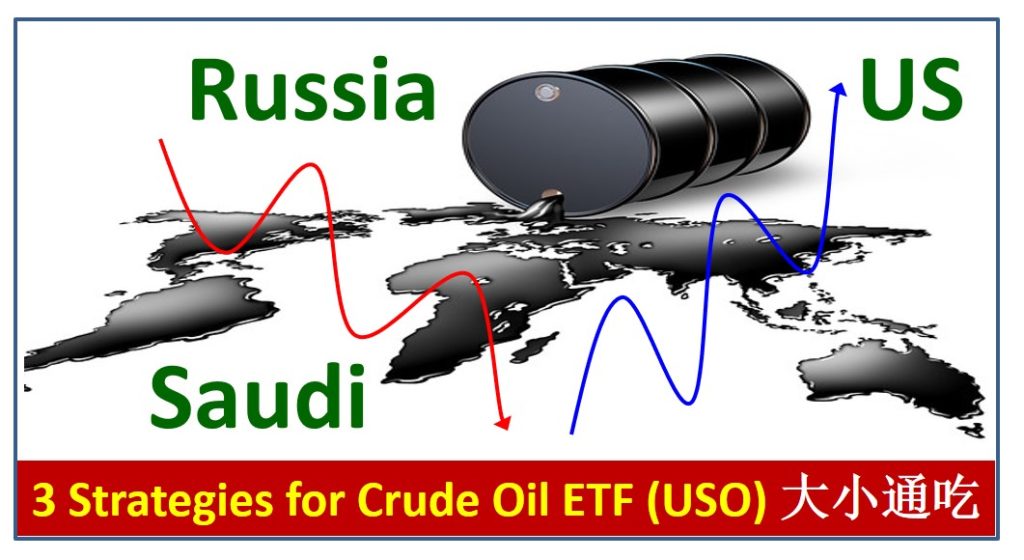
3 Strategies for Crude Oil ETF (USO) 大小通吃

Crude Oil USO ETF Strategies

When WTI crude oil falls below US$20/barrel during current Crude oil price war (between OPEC and non-OPEC), price is cheaper than mineral water (same volume) for some countries, it is attractive to buy USO (WTI oil etf) for long term, I am not surprised if Jim Rogers (long term commodity lover) may be accumulating when crude oil prices are at low optimism.

OPEC (Saudi, etc) and Non-OPEC (Russia, etc) could not sustain for long term (over a few years) with WTI < U$20, despite low production cost (about US$5/barrel for Saudi, about US$20/barrel for Russia) as national expenses of oil produces countries are also high, money from crude oil is main source of national revenue.

One may leverage on crude oil crisis, either investor or trader could benefit if aligned with own personality. WTI and Brent crude oil prices correlate well, differences are about a few dollars per barrel of oil prices. When Brent is below US$25/barrel, WTI would be near to US$20/barrel, so either price may be used for analysis, then easy to take action through USO (WTI oil ETF).

Here are 3 main strategies to invest in USO crude oil ETF:

1) Long term investors

1.1) Contrarian investors

This is suitable only if one could hold more than 3 years, use low optimism and strong holding power on a commodity giant (oil won’t drop to $0, similar to property or land, also a giant by default). Risk management includes diversification (not just invest in crude oil) with position sizing and progressive entries (eg. 10 times x 10%).

Assuming $20/barrel is the first target (use either WTI or Brent for analysis, be consistent), trigger the first buy, then when drop to $15, $10, $5, $1 (similar to car COE drops to $1, assuming something nearly impossible happens), trigger possible more entries until extreme low optimism (no one would know the lowest point but likely not $0).

Saudi and Russia are pressing the oil price down but US & China and global giant funds, may standby to buy low as national reserves. Crude oil in the world is limited in supply, therefore it has its intrinsic value, especially world needs crude oil for energy (more demand when Coronavirus crisis is over).

1.2) Trend-following (short term traders / long term Investors)

After reaching lowest point one day (only history could tell), crude oil would start to recover. The same group of investors may use the remaining capital to add more positions (still low optimism). Traders who long would also join at this phase for short term trading

Since the market trend now is bearish, trend-following investors or investors who long the market would choose “Wait” action.

2) Short term traders (shorting)
This is suitable for short term trading, aligning with current bearish trend, aiming for every major support, eg $20, $15, $10, $5, etc (these levels are just for examples)… whenever breaking below, shorting would be initiated. Traders protected by position size and cutloss (risk could be high for leveraged trade in a volatile market). S&P 500 trend over the past 1 month of falling 30% following by over 10% of weekly gain is a good example of intense fight between bull and bear.

So, one could “Buy” (contrarian investors), one could “Wait” (trend-following investor or traders who long), one could “Short” (short term traders), all 3 actions are correct if aligned with own personality. If one follows others to take action, then all 3 actions could be wrong.

Since crude oil is a giant, crisis in price is an excellent opportunity to invest with at least 3 strategies. Learn from Dr Tee 4hr Free investment course on how to take actions in crude oil and global giant stocks.
Register Here: www.ein55.com

You are invited to join Dr Tee private investment forum (educational platform, no commercial is allowed) to learn more investment knowledge, interacting with over 8000 members:
https://www.facebook.com/groups/ein55forum/

Dr Tee Investment Course (Stock, Property, Commodity, Forex, Bond)

Source of Stock Market Fear (解铃还须系铃人)

stock market fear

Based on simple calculation, with over 13k new daily Coronavirus infected cases, US will overtake Italy in 1-2 days as No 2, then in 2-3 days will overtake China as No 1 for # infected cases (based on reported data, not actual happened). Italy has shown declining number of new daily infected cases over the past 5 days.

It means the Top 3 ranking of Coronavirus would change in position in about 3 days from:

1) China, 2) Italy, 3) US

To

1) US, 2) Italy, 3) China

In fact, based on # death cases (more reliable comparison as it is easy not to report mild infected cases but difficult to ignore death cases even happened at home), true ranking should be:

1) Italy, 2) Spain, 3) China, 4) Iran, 5) France, 6) USA

Reason is there are many mild cases not reported in Europe (limited medical resources).

In Europe / Iran, fatality rate of 8-10% is much higher than norm of 1-5%, not aligned with China (5%, which is already high) and Singapore / Germany (0.5%, both countries considered golden standard as most cases are detected and treated with top medical services). So, actual fatality could be around 1% (assuming full detection but average medical services), therefore actual cases in Europe / Iran should be 10 times higher than actual. So, the actual fatality should be close to 0.5 – 1% if most infected cases are considered (including those without symptoms).

US has about 1000 death cases from Coronavirus, assuming 10x more to 10,000 cases, still 10X lower than common flu (eg H1N1) which results in over 100,000 death in US yearly.

So, it is not the deadly virus which causes the crisis. It is the fear of unknown virus which immobilize the movement of people, causing loss in jobs and income, therefore falling in stock market and economy.

So, the root of the crisis is fear, which needs to wait for # new daily cases to decline over the next 1-2 months in the world (India started later, may end later), only then the crisis may be over. Even if Coronavirus is back in next winter in Dec 2020, strain likely will be lower, could be another H1N1-like of long term virus with mankind.

=====================

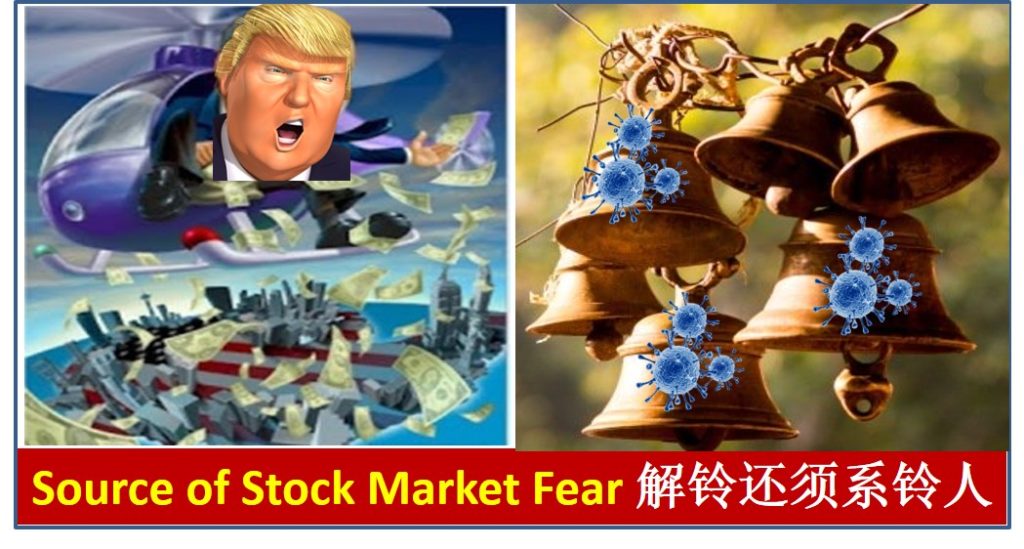
Trump knows market greed vs fear very well. Therefore, unlimited QE is introduced. In fact, the highest level of QE is no need to spend 1 cent, just an announcement to restore the confidence but actual money may take months, eventually the fear of crisis could end in summer before actual QE money is printed.

Therefore, in the past, the Fed Chairman has to think twice in wordings after each FOMC meeting, especially during Alan Greenspan time, few people understands, therefore stock market has to guess his mind. From Ben Bernanke to Janet Yellen to Jerome Powell, it is more transparent and predictable.

Global stock market is similar to Coronavirus, fact or illusion is not critical. Most important is the perception which instantly affect the emotions, greed or fear, the winner would drive the stock market up or down.

Since the source of all “evils” are fear of Coronavirus started in Jan 2020, then the crisis could only end when the Coronavirus die down around summer (解铃还须系铃人、心病还得心药医). Jan-Jun 2020 will be a record in human history, 6 months of mass vacation for most people at home, spending more time with family which was a luxury last time.

If the market fear of Coronavirus disappear in coming summer, then global stock market would have good chance to recover, with condition that current global QE must provide quick short term help in next few months to both business and individual through direct money allocation (similar to blood transfusion to a weak patient), or literary “throwing money from helicopter” to everyone to manage the short term fear to sustain the economy, until the real evil of fear, Coronavirus is away for its summer vacation.

If it is flash stock market crash (falling in Mar-Apr 2020, then gradually recover by summer), this could be a record of fastest fear and quickest greed in human investment market history. If not, then the short term fear would bring along a long term pain of global financial crisis to the world. So, summer is critical.

Learn from Dr Tee free 4hr course on how to position in global stock markets before the critical summer (Jun-July) with both counter-trend investing and follow-trend trading strategies. Register Here: www.ein55.com

You are invited to join Dr Tee private investment forum (educational platform, no commercial is allowed) to learn more investment knowledge, interacting with over 8000 members:
https://www.facebook.com/groups/ein55forum/

Dr Tee Investment Course (Stock, Property, Commodity, Forex, Bond)

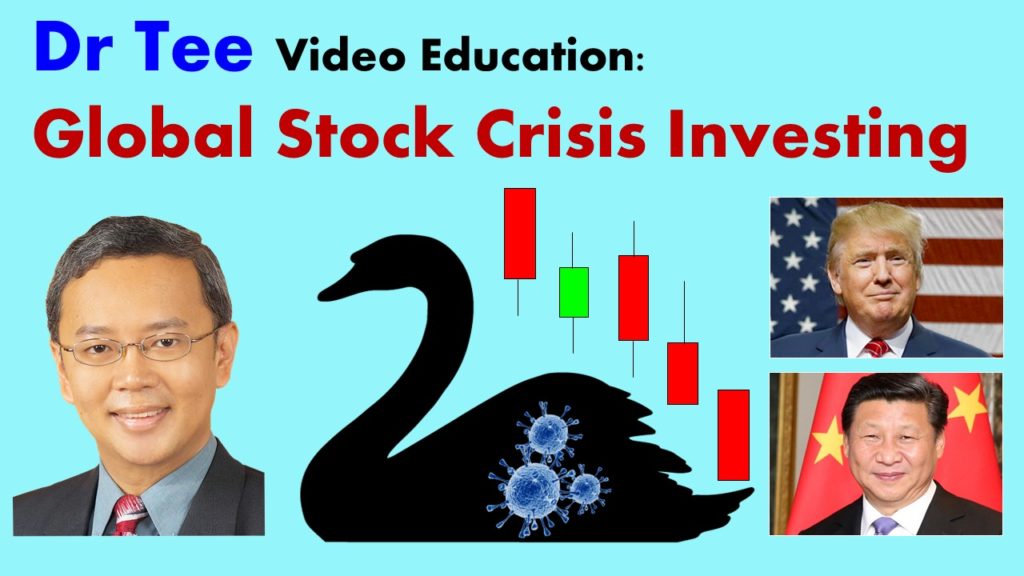
Dr Tee Video Education: Global Stock Crisis Investing

Global Stock Crisis Investing

In this Dr Tee video education (Global Stock Crisis Investing), you will learn:

1) Understand how the 2 black swans crashed the global stock market in last 1 month

2) Compare global stock market losses: US, Singapore, Hong Kong, China, Germany.

3) Technical Analysis of Coronavirus by country with stage of virus life cycle and estimated ending period.

4) Position in two possible scenarios for global stock market before summer 2020 (Jun-July).

5) Investment clock (When to Buy / Sell) with Optimism Strategies (long term / mid term / short term) for 5 global stock markets: World, US, Singapore, Hong Kong and China.

Here is English Version of Ein55 Video Course (Chinese version is available as Dr Tee is bilingual):

This crisis investing strategy may be applied to 30 Singapore STI index component stocks (investor has to focus only on giant stocks for investing):
DBS Bank (SGX: D05), Singtel (SGX: Z74), OCBC Bank (SGX: O39), UOB Bank (SGX: U11), Wilmar International (SGX: F34), Jardine Matheson Holdings JMH (SGX: J36), Jardine Strategic Holdings JSH (SGX: J37), Thai Beverage (SGX: Y92), CapitaLand (SGX: C31), Ascendas Reit (SGX: A17U), Singapore Airlines (SGX: C6L), ST Engineering (SGX: S63), Keppel Corp (SGX: BN4), Singapore Exchange (SGX: S68), Hongkong Land (SGX: H78), Genting Singapore (SGX: G13), Mapletree Logistics Trust (SGX: M44U), Jardine Cycle & Carriage (SGX: C07), Mapletree Industrial Trust (SGX: ME8U), City Development (SGX: C09), CapitaLand Mall Trust (SGX: C38U), CapitaLand Commercial Trust (SGX: C61U), Mapletree Commercial Trust (SGX: N2IU), Dairy Farm International (SGX: D01), UOL (SGX: U14), Venture Corporation (SGX: V03), YZJ Shipbldg SGD (SGX: BS6), Sembcorp Industries (SGX: U96), SATS (SGX: S58), ComfortDelGro (SGX: C52).

This powerful strategy can be extended to global giant stocks including 30 Malaysia Bursa KLCI index component stocks (investor has to focus only on giant stocks for investing):
CIMB (Bursa: 1023) CIMB GROUP HOLDINGS BERHAD, DIALOG (Bursa: 7277) DIALOG GROUP BERHAD, DIGI (Bursa: 6947) DIGI.COM BERHAD, GENM (Bursa: 4715) GENTING MALAYSIA BERHAD, GENTING (Bursa: 3182) GENTING BERHAD, HAPSENG (Bursa: 3034) HAP SENG CONSOLIDATED BERHAD, HARTA (Bursa: 5168) HARTALEGA HOLDINGS BERHAD, HLBANK (Bursa: 5819) HONG LEONG BANK BERHAD, HLFG (Bursa: 1082) HONG LEONG FINANCIAL GROUP BERHAD, IHH (Bursa: 5225) IHH HEALTHCARE BERHAD, IOICORP (1961) IOI CORPORATION BERHAD, KLCC (Bursa: 5235SS) KLCC PROPERTY HOLDINGS BERHAD, KLK (Bursa: 2445) KUALA LUMPUR KEPONG BERHAD, MAXIS (Bursa: 6012) MAXIS BERHAD, MAYBANK (Bursa: 1155) MALAYAN BANKING BERHAD, MISC (Bursa: 3816) MISC BERHAD, NESTLE (Bursa: 4707) NESTLE MALAYSIA BERHAD, PBBANK (Bursa: 1295) PUBLIC BANK BERHAD, PCHEM (Bursa: 5183) PETRONAS CHEMICALS GROUP BERHAD, PETDAG (Bursa: 5681) PETRONAS DAGANGAN BHD, PETGAS (Bursa: 6033) PETRONAS GAS BERHAD, PMETAL (Bursa: 8869) PRESS METAL ALUMINIUM HOLDINGS BERHAD, PPB (Bursa: 4065) PPB GROUP BERHAD, RHBBANK (Bursa: 1066) RHB BANK BERHAD, SIME (Bursa: 4197) SIME DARBY BERHAD, SIMEPLT (Bursa: 5285) SIME DARBY PLANTATION BERHAD, TENAGA (Bursa: 5347) TENAGA NASIONAL BHD, TM (Bursa: 4863) TELEKOM MALAYSIA BERHAD, TOPGLOV (7113) TOP GLOVE CORPORATION BHD.

===================================

There are over 1500 giant stocks in the world based on Dr Tee criteria, choice of 10 Dream Team giant stocks have to align with one’s unique personality, eg. for shorter term trading (eg. momentum or swing trading) or longer term investing (cyclic investing, undervalue investing or growth investing). Readers should not just “copy and paste” any stock (What to Buy, When to Buy/Sell) as successful action taking requires deeper consideration (LOFTP strategies – Level / Optimism / Fundamental / Technical / Personal Analysis) which you could learn further from Dr Tee Free 4-hr Webinar.

Zoom will be started 30 min before event, bonus talk (Q&A on any investment topics from readers) for early birds. There are many topics we will cover in this 4hr webinar, Dr Tee can have more time for Q&A if you could stay later after the webinar.

Dr Tee will cover over 20 case studies, Singapore giant stocks, eg. CapitaLand Mall Trust (SGX: C38U), Singapore Exchange (SGX: S68), Keppel Corp (SGX: BN4), Top Glove (SGX: BVA), Jardine Matheson Holdings JMH (SGX: J36), Vicom (SGX: WJP) and many others, Malaysia giant stocks, Hong Kong giant stocks and US giant stocks, both long term investing and short term trading.

There are limited tickets left for this 4hr free webinar, please ensure 100% you could join when register: www.ein55.com

Uphill Task to Invest in Stock Market Crisis

Invest in Stock Market Crisis

When Dow Jones Index drops below 20000 points during intra-day today (quickly recover above it, although may fall below again in near future), this is about last 3 years low. This implies an investor is saving 3 years of investing time if investing in current level. So, when one could invest in last 10 years low for a major stock index (eg. US S&P 500 or Dow Jones Index), it means the crisis helps one to “jump queue”, saving 10 years of waiting time.

So, when looking backward, history does help one to decide the entry and exit, especially the stock market cycle which could be 5 to 10+ years long. Current bull for global/US stock market (Mar 2009 – Mar 2020) is 11 years, the longest in the history of stock market so far, after US stock market lost more than 1/3 of market cap so far, Dow Jones Index falls from nearly 30000 to 20000 points in 1 month. Despite a bear market is confirmed, this is not yet low optimism < 25% based on Ein55 styles, only a mid-size bear so far.

However, the waiting time has to include the fall + recovery again, therefore some investors prefer to wait till the uptrend phase before entry which is easy to miss the boat (1 chance left) when an entry price is not defined. If an investor enters as contrarian approach first, there are at least 2 chances: fall below the desired entry price and again above the entry price after a period of waiting.

Ein55 members, please plan your entries, how many bullets to use: 1 shot or multiple shots. Don’t end up no shot at all when the game is over.

Learn from Dr Tee free 4hr investment course to plan for your “bullets” to shoot, investing in stock market with LOFTP (Levels 1-4, Optimism 0-100%, Fundamental – Strong/Weak, Technical – Up/Down, Personal – Trade/Invest) Strategies to leverage on current global stock market crisis. Register Here: www.ein55.com

You are invited to join Dr Tee private investment forum (educational platform, no commercial is allowed) to learn more investment knowledge, interacting with over 8000 members:
https://www.facebook.com/groups/ein55forum/

Dr Tee Investment Course (Stock, Property, Commodity, Forex, Bond)

Stock Market Fear with 0% interest rate and $700B QE

Stock Market Fear with 0% interest rate and $700B QE

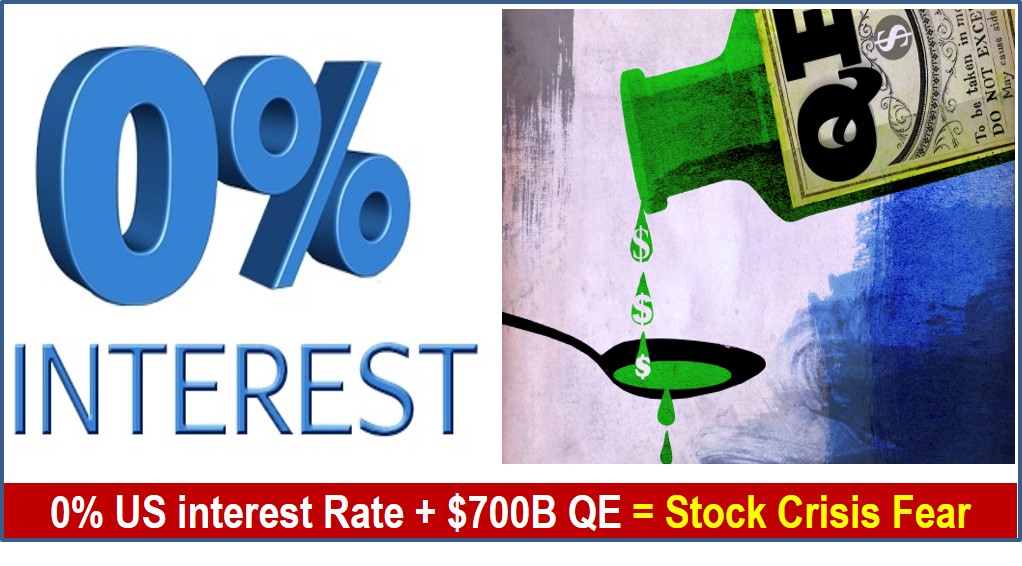
0% US interest Rate + $700B QE = Stock Crisis Fear

US Fed just cut interest rate to historical low of 0-0.25% + strength of $700B QE (Quantitative Easing) but introducing on bearish stock market. This is wasting bullet. In fact, global stock market falls more due to fear of such action, US stock market is halted due to circuit breaker with 7% fall.

A natural way is to let the market reset itself with a global financial crisis and falling of global stock market to low optimism < 25%. However, this would affect the chances of Trump second term presidential election as S&P 500 has been his report card, hard to show negative results to his supporters who may also be investors.

If US stock market (Level 3) falls to low optimism <25%, world stock market (Level 4) would also follow, officially falling into Global Financial Crisis which may last longer than 6-12 months, depending on the severity. It would be timely to consider cyclic giant stocks from sectors such as bank, property, airline, technology, etc, focusing on strong fundamental stocks only, don’t buy stock purely based on prices (eg. historical low price).

======================================

A stock market could only reborn after falling to worse case of <25% optimism, then measures such as QE1 in 2009 could be effective (limited downside then).

US stock market is still at 50% optimism, Trump tries an uphill task to save the stock market by introducing interest rate cut to 0% and massive QE of $700, it is wasting money and effort. Stock market bubbles may be burst, money would escape from stock market, even from bond market (since bond yield is <1%), holding as cash which is king but low interest rate would push some investors to invest again in future, after global financial crisis with low prices of stocks everywhere. 

It would take time to recover or if Trump is lucky, Coronavirus may end by summer, then it could still be a mini bear, but fear in stock market may spread faster than Coronavirus over the next few critical months, depending on global countries, need to fight 2 crisis (health + stock) together.

Learn further from Dr Tee, strategies to integrate economy with stock market: www.ein55.com

You are invited to join Dr Tee private investment forum (educational platform, no commercial is allowed) to learn more investment knowledge, interacting with over 8000 members:
https://www.facebook.com/groups/ein55forum/

Dr Tee Investment Course (Stock, Property, Commodity, Forex, Bond)

Strategies for Great Stocks Sales (狡兔三窟)

Strategies for Great Stocks Sales

Over the past few years, due to high optimism (>75%) in Level 3 (US) and Level 4 (World) stock market, focus has been in shorter term trading / investing, as if carefully walking on thin ice. With recent sudden meltdown of global stock market from bull to bear market with over 20% correction, now there is more opportunity for longer term investor as significant discount is given for many giant stocks, especially for cyclic sectors (eg. bank / property / airline / technology stocks, etc).

We don’t have to buy stocks at the lowest price (not possible to time the market this way unless one is very lucky but even so, luck may once come once, speculative in this way) but we could buy at low enough prices, eg following discount in share prices below the intrinsic value. Warren Buffett is fine to buy “wonderful business at fair price”. If one could buy giant stocks with strong fundamental at undervalue prices (almost a steal for unfair price with fear created by market), then one should grab on the rare opportunity.

Similar as shopping, we don’t have to buy at the lowest price (best discount) of a handbag in a town because there could be always another competitor offering a lower price a few days later. If a buyer is hesitating (greedy to buy at the lowest or no deal), may end up not buying anything at all, when keep on waiting for the best deal with no clear ending.

Instead, define a discount comfortable to oneself (eg. 20%-50%) compared with regular prices, be happy with the purchase. As an investor, more importantly is to achieve a consistent profit over a longer period, not a cyclic performance (big win or big loss) in short term which could be stressful.

It is the same as searching process for life partner (potential husband or wife), one could not keep on waiting and hoping for the “best” as one may not have the time and luck, each opportunity missed, may end up a single for life. Some may have stricter criteria for boy friend or girl friend or life partner before settle down, this is personality based, but when criteria is too high, may not be realistic.

Luckily stock investment is easier than choosing a life partner. One could diversify the risk of timing into several entries or exits. For example, when stock market is falling to a desired low price (but may have further downside due to bearish trend), an investor may trigger the first buy with contrarian approach (similar to Warren Buffett styles) with 1/3 capital. When stock market has chance to drop to a historical low point (eg. low optimism of recent crude oil price, can be traded with USO oil ETF), then one has option to trigger another 1/3 capital. Finally, when market is recovering with clearer uptrend (but much higher prices than previous 2 entries), one may use up the remaining 1/3 capital. This strategy of capital allocation is best described with Chinese idiom of a clever rabbit with 3 caves to hide from potential enemy (狡兔三窟), similar to diversification of “timing risks” over a period of low or high optimism.

Unsystematic risks (eg. negative news related to business, management, etc) could be minimized with an investment portfolio of 10-20 giant stocks with strong business fundamental. Even one may have limited capital (eg $1000), may consider ETF (eg. MSCI World stock ETF) to diversify over 1000 global blue chip stocks.

At the same time, systematic risks (eg. black swans related to global financial crisis, changes in political economy – interest rate / inflation, etc) could be minimized with entry of global stock market at low optimism <25% (currently 38% optimism), exit at high optimism > 75% (eg. over the past few years). Apply probability investing strategy with optimism, instead of speculating in daily stock market, guessing what could be the next move of Trump or possible market responses.

In fact, over the last few years, global stock market has exceeded 75% optimism 3 times, creating 3 times of “wolf is coming”, currently the third wolf (falling down from 75% optimism) has become a mini bear with over 20% stock market correction, if market fear is not controlled over the next few months, resulting in real economy is affected (eg. lower quarterly GDP) or hurting other investment markets (eg. property), then it could evolve into a big bear, i.e. global financial crisis, which would have over 50% major correction in global stock prices.

“Luck” is an opportunity given fairly to everyone but only accepted for those who are prepared and ready to take actions when conditions for actions (Buy / Hold / Sell / Wait/ Shorting) are aligned with own personalized investing strategies or trading plans.

Learn from Dr Tee free 4hr investment course to accept this gift from heaven, saving 5-10 years of investing period when one could invest at the right time during severe stock crisis on global giant stocks. Register Here: www.ein55.com

Dr Tee Investment Course (Stock, Property, Commodity, Forex, Bond)

What to Do in Stock Crisis Now?

actions for stock crisis

Global stock markets (including US & Singapore) have fallen over 20% from the peaks of indices over the past 1 month, fulfilling the common technical definition of a “Bear Market”. Global and local stock investors who still have stocks now are worrying (stocks may have dropped by 20-50%), not sure what to do under dual crisis of Coronavirus and crude oil Market.

Although global financial crisis is not confirmed yet (so far is still a mini bear, even with 20-30% stock indices correction), it has potential to get worse if country economy is also affected (i.e. recession if next few quarters have negative GDP growth) and other investment market (eg. property, typically effect will be shown in about 3-6 months after stock crisis) may all fall.

Here are 5 KEY actions to take in stock crisis now, depending on individual investor:

1) Hold

This action is more suitable for longer term investors investing in defensive giant stocks with strong business fundamental, collecting dividend consistently, even during stock crisis. Only about 5% of global stocks are defensive (relative to stock indices and blue chips), could within the impact of global financial crisis. 95% of global stocks will be affected by this systematic risks of global financial crisis, falling down more than 50% in share prices.

2) Buy / Wait

Yes, it is time for Ein55 members to do homework to pick up dream team stocks aligned with own personality.

Ein55 graduates may consider over 1500 giant stocks globally. Many stocks are heavily discounted but currently more suitable for contrarian value investor who has strong holding power as short term price trend is still bearish. Integrate LOFTP strategies together to plan for this rare gift from heaven.

For general public (non-Ein55 graduate) who are not trained for Ein55 investing styles, you may attend free 4hr investment course by Dr Tee, you will learn how to position on global giant stocks: www.ein55.com

Each of you just needs to shortlist 10-20 giant stocks to form a dream team portfolio, then align strategy with personality to plan for entries in batches.

“What” to Buy does not mean “Now” to Buy. Since the short term stock market now is bearish, “Buy” action now is more suitable for contrarian investor (eg. Warren Buffett). There could be more downside (despite over 20% stock market correction), optimism analysis is required, especially for Level 3 (US) and Level 4 (world) for stock markets.

Some investors may prefer to “Wait” for reversal in prices, integrating trading into investing, buying low enough, but no need to aim for the lowest prices (no possible unless one is very lucky, but luck may only come once, as good as speculation). In short, don’t greedy to buy at the lowest, just buy low enough.

3) Sell / Shorting

Sell action could be a bit late (falling from 90% to nearly 50% optimism for US stock market, already a fair value but not yet low optimism which is undervalue) but it is never too late, especially if investor has stocks with weak fundamental. Loss aversion psychology may encourage potential sellers to hold on to junk stocks, resulting in more potential losses over next 6-12 months if stock crisis gets worse.

Alternatively, an investor could apply “Shorting” to hedge against the current position, buying an insurance from further downside of stock crisis.

Experienced traders are happily look for many opportunities during stock crisis now to short (profiting from falling of stock prices). However, shorting requires strict compliance with trading plan (SET: Stop Loss / Entry / Target Prices), especially during the volatile stock market which could move up and down by 5 to 10% daily for indices, 10-20% daily for individual stocks.

===================

Current stock market crisis could be just a flash crash (with V-shape recovery if Coronavirus may end in summer as China epidemic was about 4 months from Dec 2019 to Mar 2020, rest of the world is delayed in outbreak, could be Feb – Jun 2020 for pandemic). It could also trigger a more severe global financial crisis (if economy is affected starting from airline / consumer / retail sectors, together with falling of property market, over next 6-12 months).

Regardless it is a mini bear (major correction) or big bear (global financial crisis), both are significant opportunities, gifts from heaven for those who are prepared.

Take Action (Buy / Hold / Sell / Wait / Shorting) for Stock Crisis Now. If you are unsure how to take the right action for yourself (unique personality), learn from Dr Tee free 4hr course on formation of a dream team stock portfolio in this perfect storm, converting crisis into future wealth: www.ein55.com

Dr Tee Investment Course (Stock, Property, Commodity, Forex, Bond)

3 Levels of Stock Market Crisis (Wolf, Mini / BIG Bears)

3 Levels of Stock Market Crisis

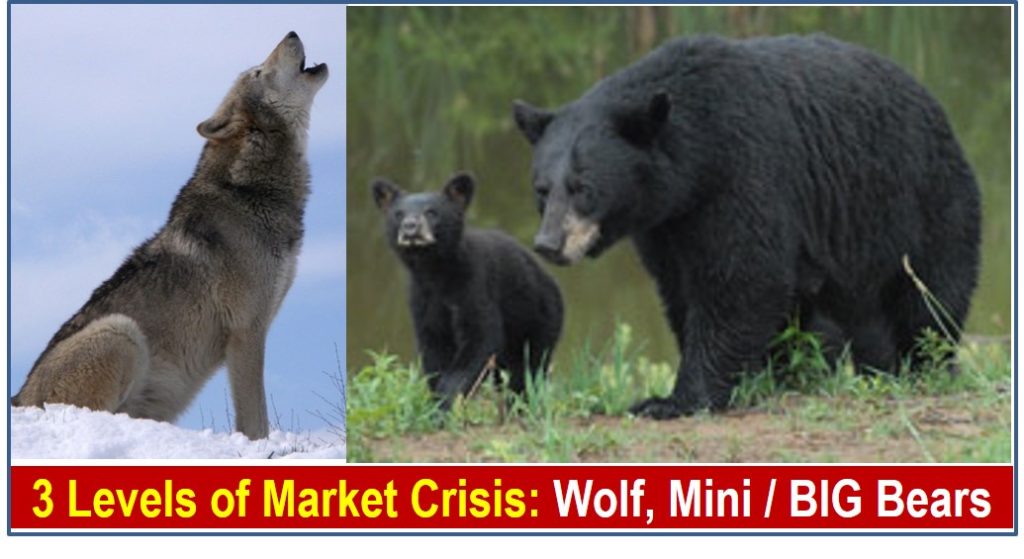
Every 10 wolves (eg. 10% minor stock correction, could be yearly) may lead to 3 mini bears (eg. 20% major stock correction, could be every 1-3 years), eventually only 1 becomes the BIG bear (eg. over 50% stock market crash, could be every 10+ years) or commonly known as Global Financial Crisis.

For stock investing or trading, one has to know own personality which includes preferred timeframe of investing and holding power, aiming for 3 levels of stock market crisis which could be represented by these 3 animals:

1) Wolf (Short Term Trading)

Short term investor (usually is also a trader) may need to take action every few weeks or few months, responding to daily positive/negative news which may cause the stock price to up/down by about 10%. A common tool is Technical Analysis, analyzing price trend and also support/resistance of stocks (eg. exit when S&P 500 is below 3000 points).

Trend-following strategy is flexible (similar to a wolf who is very alert to surrounding), suitable for traders, although many times, could end up as false alarms to longer investors who hear “wolf is coming” (eg. market recovers again after price correction).

2) Mini Bear (Mid Term Trading)

Mid term investor or trader could have higher tolerance level, able to hold longer (eg. more than 1 year) for up and down of about 20% in stocks. A Mini bear may come when there is a regional crisis (eg. Euro Debt crisis, US losing AAA credit rating, etc) or unexpected events (eg. Coronavirus, Oil Crisis, etc). It is a mid-scale crisis which could cause significant harm, but could be intermediate opportunity to buy low when crisis is over a few months later.

A mini bear is welcomed by both investors and traders as it won’t end the bull run but creating more opportunities along the long journey of bull market (eg. current bull run is already 11 years long from 2009 to 2020).

3) BIG Bear (Long Term Investing)

The scary BIG bear is a threat for global investors and traders who know how to buy stocks but do not know how to exit because the drawdown could be more than 50%. For junk stocks with weaker business fundamentals, some may be swallowed by the BIG bear, ending in bankruptcy, an investor could lose 100% investment permanently in this coldest winter which could last more than 1-2 years (Great Depression in 1929 could take more than 5 years).

At the same time, the BIG bear or global financial crisis provides an excellent opportunity to redistribute the wealth globally, from those who are ignorant to those who are prepared, smart investors who have found a portfolio of global giant stocks with strong business fundamental, using the BIG bear to scare away other competitors to get a huge discounted price to own them for another 10+ years of new market cycle (which the investor later could decide whether to hold for long term or sell at next market high).

=======================

No one would know exactly when the BIG bear may come. We don’t have to scare ourselves every year whenever there is a wolf calling (action for short term trader) or even hearing the steps of mini bear (alert for mid term trader).

For longer term investor, one could apply probability investing with optimism to know when to stay alert, the time when global stock market at Level 4 (especially US stock market, Level 3) exceeds 75% optimism (eg. over the past 2 years). The investors who prefer not to exit first (to ride the price momentum in last rally of bull run), then need to protect oneself with shorter term trend-following strategy during the uncertain stock market at high optimism.

In summary, despite we may know not precisely when the global financial crisis may come, we could evaluate the probability based on signals received along the way, eg. stock market optimism (Levels 1-4 Analysis), business fundamental and country economy (Fundamental Analysis), Price trends (Technical Analysis), Market High or Low (Optimism Analysis) and more importantly, knowing if one’s personality (Personal Analysis).

Learn the unique LOFTP Strategies from Dr Tee free 4hr course to prepare for 3 levels of crisis (Wolf, Mini Bear or BIG Bear). Register Here: www.ein5.com

Dr Tee Investment Course (Stock, Property, Commodity, Forex, Bond)