Acquisition of Dividend Giant Stock: Challenger Technologies (SGX: 573)

Based on Ein55 Giant Detector, out of about 800 stocks, there are only 6 dividend giant stocks in Singapore.  Unfortunately, 1 of the dividend giant stocks, Challenger Technologies (SGX: 573), is being acquired recently, will be delisted from Singapore stock market.


Challenger Technologies is not a REIT nor blue chip stock, but it has strong earning growth with stable positive operating cashflow, able to pay consistent dividend each year (more than 5% dividend yield) over the past 10 years.  Due to weak stock market sentiment, Challenger Technologies has been trading at low Optimism level (<25%) over the past 2 years, providing a golden opportunity for major shareholder (Loo family in partnership with Digileap Capital) to acquire at low price of $0.56/share, which is a premium of about 20% compared with average low optimism price of $0.48/share (when homework on Challenger Technologies was assigned to Ein55 coaching class in Feb 2017) over the past 2 years. The timing of acquisition is ideal as Challenger Technologies has low trading volume with little public float, even with offer price of $0.56/share, it is still consider undervalue.
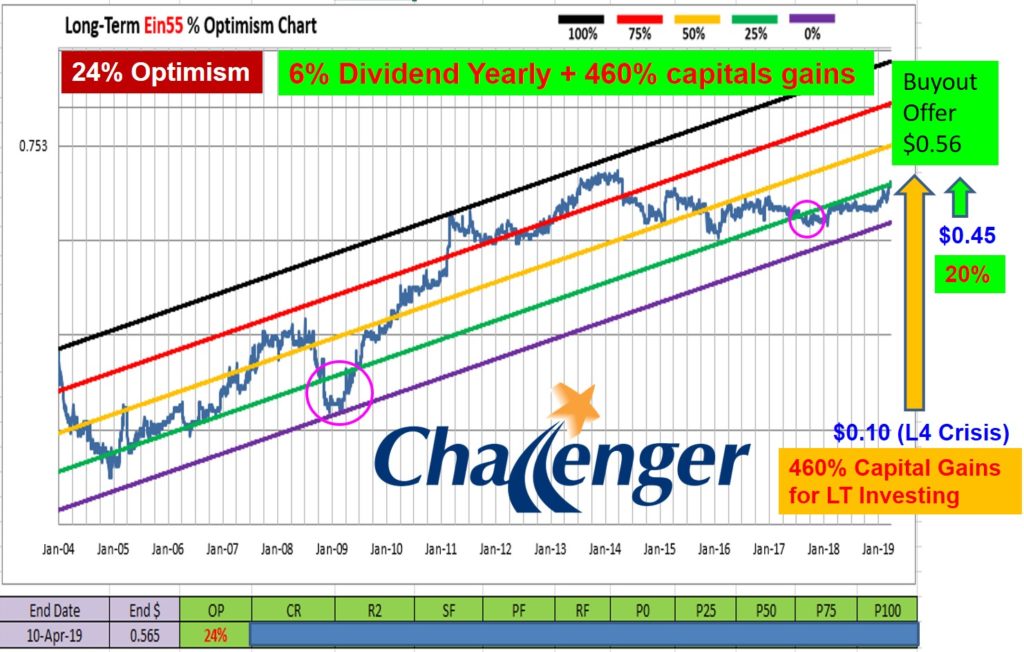
Over the past 10 years, Challenger Technologies has grown more than 5 times in share prices (from initial low of $0.10/share to more than $0.50/share), an ideal growth stock for buy and hold for tremendous capital gains, as well as collecting more than 5% dividend yield yearly as bonus (13% dividend yield if bought in year 2008 during global financial crisis).  Most investors may position dividend as the No 1 objective for dividend stock investing.  In fact, the hidden treasure of dividend stock is with the enormous capital gains (rise in share prices over the years) as other investors have to pay higher prices each year to exchange for this money-making machine which pay $5 for every $100 investment. Challenger Technologies is an excellent example of dividend giant stock which is suitable for both passive income and also capital gains.


Investors have been given at least 2 years to consider Challenger Technologies but the response has been weak, partly because the stock is not a typical trading stock with high volatility.  In total, there are 86 giant dividend stocks in the world major stock markets. After delisting of Challenger Technologies, there are still another 5 dividend giant stocks from Singapore waiting for us, do not miss these limited opportunities, especially when they are trading at low optimism price with high dividend yield (>10%) one day during the global financial crisis while business is still strong to make money consistently each year.


Interested readers may sign up for free 4hr stock investment course by Dr Tee to learn the right way of dividend stock investing, as well as timing for entry and exit, through 10 personalized investing strategies. Register Here: www.ein55.com

Dr Tee Investment Course (Stock, Property, Commodity, Forex, Bond)


Investing Strategy in Monopoly Stock Exchange – SGX Stock (S68)

Stock exchange is a monopoly business, sponsor usually is by the government of entire country because stock market is an engine to provide capital for growth in business (Level 1 – individual company) and economy (Level 3 – country).  At the same time, stock exchange usually is a profitable business for major economy, growth depends on trading volume of stocks and other derivatives, number of stocks listed and new IPO yearly, etc.  Let’s learn the monopoly stock strategies (Optimism with FA + TA + PA) to profit from global stock exchange stock, using SGX stock (S68) as an example:


1) Personal Analysis (PA)
SGX has strong sponsor of Singapore government which is AAA credit rating.  Not all the monopoly stocks are good choices for investing, especially for declining industry.  SGX is a reflection of Singapore economy through stock market, a growing financial industry.  Liquidity is a major constraint for SGX, therefore SGX has to collaborate with regional stock exchanges to promote flowing of investing funds globally.

2) Fundamental Analysis (FA)
Buy a stock means one is in partnership with someone doing business together.  It is meaningless to buy cheap (common mistake for a beginner investor) for a stock if one does not know the value in business.  SGX stock has over 30% ROE for the past 13 years, a strong growing company with stable positive operating cashflow generated each year.  It is also a stable income generator (due to stable positive free cashflow) with yearly dividend yield of about 3-4% for the past 10 years (except for 7.5% dividend in year 2008 during subprime crisis due to drop in share prices with stable dividend).

3) Technical Analysis (TA)
SGX stock has been oscillating +/-30% between a tight price range of $6+ to $8+ for the past 10 years (correlating well with stable STI within 3000 +/- 300 points), a simple investing + trading strategy could be buying SGX share just above $7 while it is uptrend, shorting just below $8 while it is downtrend, collecting about 3-4% dividend along the way during the holding period (as if a fixed deposit in stock market with 3-4% “interest” if one ignore the little movement of share prices, double of 1-2% bank interest rates over the past 10 years).

SGX is a monopoly stock with strong fundamental (FA), protected indirectly by trusted sponsor, the Singapore government (PA), therefore a giant stock. A trader could simply apply optimism & TA to buy low sell high while it is moving in a cyclic way.    

4) Optimism Analysis
Long-term Optimism of SGX stock is about 10% currently, considering an investing opportunity to invest at low optimism <25%.  However, there are different qualities of low optimism or “crisis” stocks (price is much less than value), SGX low optimism at Level 1 (company) is not aligned with optimism at Level 2 (Financial Sector), Level 3 (country level, STI which is at mid optimism level of about 45%) or Level 4 (world level which is about 70% optimism for global stocks).  Therefore, SGX is more suitable for swing trading (within $7-$8 share price range) in short term and/or dividend investing in medium term (collect 3-4% dividend yearly), instead of investing for long term (a global financial crisis is required to correct the share prices, only then one could invest to buy low and hold long term).
Interested readers may study other global stock exchanges, selecting a suitable one for possible investment, ideally aligning with Levels 1-4 crisis to buy low. FA performance and credit rating of sponsor (respective country) for different exchange could vary, do your own studies to compare with global stock exchanges, eg. Bursa, HKEx, etc.

There are other much better global monopoly stocks in the world, especially in private sectors which can have control over the prices of products or services to generate enormous profits. Another close example is ICBC (HKEx: 1398), world largest bank, a cyclic trading stock protected by FA & PA, similar strategy as SGX may be applied.

Interested readers may learn from 4hr free stock investment course by Dr Tee to learn the complete 10 strategies, including discussion of many local and global giant blue chip stocks with potential.  Register Here:  www.ein55.com

Dr Tee Investment Course (Stock, Property, Commodity, Forex, Bond)

Best World Stock – To Invest or to Trade?

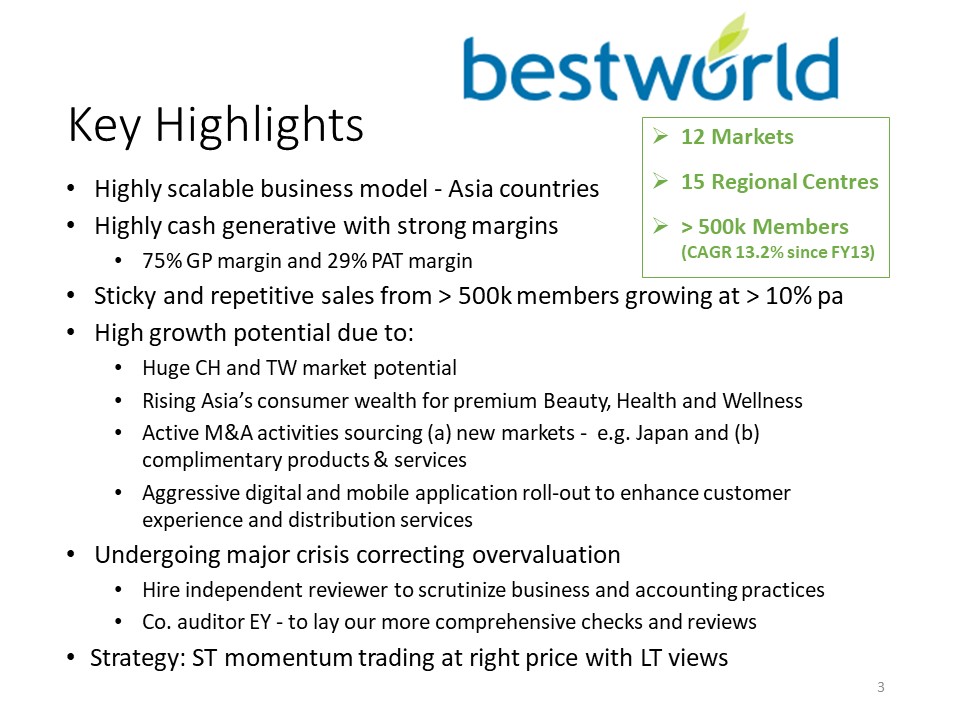
Before Best World stock announces FY 2018 results, Ein55 students could project this positive results many months in advance as the company hassustainable growing business. So, Best World management is smart to announce the corporate news (reply to Business Times) before good 2018 corporate results. When the fear is gone, as long as global stock market is strong, Best World stock has chance to recover again above $3/share as most people are greed & fear driven in stock market.

Valuation of Best World stock is not so much based on asset approach (unlike property or bank stocks), it is more on future earning capability, as well as 10X market potential in China. Currently both China and Taiwan markets contribute to bulk of earning.


Best World stock has recovered in share prices back to above critical support of $2.70, to the level before the trading halt. Temporary, the Level 1 (company) crisis is relieved unless the Business Times could find more negative points.

The main question mark on Best World may be still the “secret” of business model driving the sales, how it could make money in a sustainable way. Although investors may not have full info on direct customers (final users of beauty products), Best World management might know the estimated numbers or trends which could be a trade secret from competitors.

In this beauty industry, Ein55 coaching homework (see sample attached) shows that Best World has the highest profit margin but share price growth is much faster than the earning growth. If one could trust the auditor E&Y, this is a strong growth stock but at speculated high prices (more than 10 times growth in share prices over the past few years).

In conclusion, Best World may be more suitable for trading, not for investing as the stock is at high optimism. When price is recovering well, it could be a momentum stock as well, one could buy high sell higher. When price momentum is lost or there is a higher level (L3 country or L4 world) crisis, one may need to exit as a trader as well.

Global stock market has turned bullish over the past few months. Readers may learn from Dr Tee free 4hr stock investment course to learn various global giant stocks for long term investing or short term momentum trading. Register Here: www.ein55.com

Dr Tee Investment Course (Stock, Property, Commodity, Forex, Bond)

Key Learning Summary of Ein55 Business Analysis Course: Business Valuation

Ein55 Business Analysis Course - Business Valuation

The Ein55 students have learned the details of Business Analysis Course #2 (Business Valuation) from Ein55 Mentor Kean Lim, understanding how to evaluate values of a company with stock, as well as avoiding accounting traps.  Here is the key summary:

1) Check what is the Auditor’s Opinion

– Unqualified / Qualified / Adverse / Unable to give an opinion (Disclaimer)

2) Know why ROE is rising or falling, high or low

– Net profit margin, Asset turnover, Financial leverage

3) Check whether a company uses Aggressive Accounting

– Aggressive revenue recognition

– Days Sales Outstanding

– Days Inventory

– Large changes in operating expenses

– Over-dependence on acquisition

– Quality of earnings

4) Derive the intrinsic values based on

– asset value

– earning value

– growth value

5) Combine various valuation methods with Optimism Strategies

– buy at price below the value, selling at price above the value.

6) Investor can purchase the best stock in the world, but if one buys it at a high premium, it can be a bad investment.

– Valuation is important and is a huge part of the game.

Investing in a company is akin to being in partnership with its business. It is therefore crucial for investors to possess the ability to analyse and make sense of the businesses of interest. The beauty of investment is that one can be selective to only invest in businesses that are profitable and therefore can bring about considerable capital gains in future.

Dr Tee provides free high-quality investment education regularly to the general public, including Business Analysis (BA), Fundamental Analysis (FA), Technical Analysis (TA), Optimism Analysis (OA) and Personal Analysis (PA). The knowledge could help a person for a lifetime, after mastering the right skills of stock investment.  Register Here.

Dr Tee Investment Course (Stock, Property, Commodity, Forex, Bond)

3 Strategies on Oil & Gas Stocks Investing

Oil & Gas Stocks
Winter time (low optimism) of crude oil is longer than expected, after recovery over the past few years, it corrected down again over the past 1 year, recovering again over the past few months. Many oil & gas stocks, especially for upstream sector, revenue of business is very much dependent on crude oil price, therefore the cyclic business performance has resulted in cyclic share prices.
 
For oil & gas stocks, besides business fundamental, success in stock investing or trading is mainly dependent on alignment with prices of crude oil which trends are time-dependent. Here are 3 strategies for 3 different types of investors with 3 different personalities:
 
1) Long Term Investor (decades): Uptrend (Low Optimism)
Unlike stock market with market cycle of about 10 years, crude oil is a commodity which has a much longer market cycle of 20-30 years, therefore a very long term view (decades) is required. Crude oil is a critical energy related commodity, its price could not drop to $0 as a commodity (possible for stock in crisis), therefore it is a giant in nature. Similar to property, long term trend of crude oil is increasing over the decades, currently at low optimism (potential buying zone). However, if an investor does not have holding power, could make a loss as buying low could ending up lower if holding power is weak.
 
Currently, the second dip over the past 5 years have established a higher low which is a strong support to crude oil long term investor. However, since global stock and property markets are at moderate high optimism, if the next global financial crisis is triggered by another asset class of investment market, commodity market could be affected despite the optimism is not high as global funds are connected through common pool of investor with money.
 
Therefore, it is relatively safer to hold a shorter term position, applying trading on oil & gas stocks. One could compromise to become a “short term investor”, i.e. buying strong fundamental oil & gas stocks as if an investor but buying or selling the stocks by following the price trends in shorter term as if a trader. This is an integration of trading into investing in view of global economy and stock market.
 
2) Medium Term Trader (years): Uptrend (Moderate Low Optimism)
Medium term trading is a compromise between investing and trading. Current trend is uptrend at moderate low optimism with recovery in prices of both crude oil (commodity) and oil & gas stocks over the past few months which is ideal for trader who is interested in buy low sell high for capital gains. However, since the market uncertainty is high (eg. unknown on outcome of US-China trade war negotiation by 1 Mar 2019), a trading plan with S.E.T. is required: Stop Loss, Entry Price, Target Price.
 
Despite focusing in trading, a trader could consider strong fundamental oil & gas stocks (eg. growing or recovery in earning and cashflow), avoiding stocks with relatively high debt (eg. Debt/Equity >> 1) which may not last through the winter time of crude oil.
 
3) Short Term Trader (months): Downtrend (High Optimism)
Over the past 6 months, for short term traders (buy low sell high every few months), the current trend for oil & gas stocks is downtrend at high optimism, aligning with direction of crude oil. The probability is higher for shorting, especially when supported by some negative financial news (eg. US-China trade war, UK Brexit, China economy slowdown, bankrupt of another oil & gas company, etc). Similarly, shorting in short term requires a trading plan with S.E.T., except the strategy is reversed (making money when price is falling). A trader who is not comfortable with shorting (higher potential risk when not managed properly) may also adopt a “Wait” strategy, waiting for stronger uptrend of crude oil and oil & gas stocks.
 
Of course, for very short term traders (weeks or days), there are different trends and optimism. There are always trends within trends, depending on timeframes of investing which is personality dependent. Therefore, before an investor or trader plan on position of stocks, should strongly consider own holding power, risk tolerance level, reward expectation, emotional control, etc.
 
Interested readers may learn from Dr Tee free 4hr course to construct a dream team stock portfolio with global blue chip stocks (including oil & gas crisis stock investing). Register Here: www.ein55.com
Dr Tee Investment Course (Stock, Property, Commodity, Forex, Bond)

How to Buy Stock as If Driving Investment Car?

How to Drive Investment Car
Stock trading is similar to driving a car.  The driver should have obtained a license to drive. An experienced driver could drive safely even using one eye or one hand holding the steering wheel. If the car is given to a 8 years old kid, this could be a disaster. Similarly, a stock trader should master the skill to trade, a licence to drive the investment car.  A beginner who starts stock trading or investing without proper knowledge is considered risky while an experienced investor is used to the thunderstorms (financial crisis) in stock market, knowing when to slowdown or speed up.
The driving skill would give the driver a good start but it could not guarantee safety all the time as car condition could be different. A strong car is similar to strong fundamental stock, even when there is an unexpected accident (financial crisis), it could protect the driver (investor).  In the world of stock market, an investor could even diversify the risks with 10 stocks, as if having 10 different cars driving at the same time, even when one breaks down, there are other 9 other choices to move on, journey of financial freedom is not affected.
For additional safety, besides wearing safety belt, a driver could buy comprehensive insurance coverage to protect against unforeseen accidents. Similarly, an investor could consider low-debt strong cash company for investment as safety belt, following price trend with breakout for confirmation as premium for insurance.
Some drivers (traders) like a fast Ferrari (short term trading) while others prefer slower antique car (long term investing), there is no right or wrong in the choice. Each driver has to operate the car within safety margin under own’s control.  Beyond the limitation, accident could happen which is beyond driver’s tolerance level.  Similarly, a stock trader or investor has to know the risk tolerance level and reward expectation.  Alignment of personality with own investment strategy is the key for success. A good driver would find own’s favorite car which matching own needs: price, color, speed, functions, etc.
So, have you found your desired car (stocks) for investment? Learn from Dr Tee through 4hr free high-quality stock investment course to learn how to form a strong investment portfolio with 10 dream team stocks globally.  You will master What To Buy, When to Buy/Sell through Fundamental Analysis (FA), Technical Analysis (TA), Personal Analysis (PA), integrated with Optimism Strategies. Register Here: www.ein55.com
Dr Tee Investment Course (Stock, Property, Commodity, Forex, Bond)

Investing in Parent Stock vs Subsidiary Stock

When 2 large businesses are combined, it does not mean it would become a giant stock. Capitaland + Ascendas-Singbridge of Temasek are merged into the 9th largest global property investment company (Asian largest), 51% shares is under control of Temasek.
 
Before merging, Capitaland has been a slower growth giant stock due to its large size. An investor may not need to consider large parent company. Instead, its subsidiary company with much smaller size could be more profitable, eg. Capitamall Trust (SGX: C38U) of Capitaland and Ascendas Reit (SGX: A17U) are stronger REIT / property giant stocks than its parent company stock.
 
A giant is not defined by its size of business, but by its internal strength of strong fundamental. An investor could have the best of 2 worlds investing in a strong subsidiary stock of a large parent company (fine if slow in growth), enjoying the fruit of profitable business in smaller market with protection of parent company.
 
For example, one could invest in Vicom (nearly monopoly business) with protection by parent company, ComfortDelgro. During the last subprime crisis in year 2008-2009, share price of Capitamall Trust drops significantly, Capitaland strongly support this subsidiary with injection of more funds during global financial crisis.
 
Learn from Dr Tee in free 4hr stock investment course to invest in various giant stocks of small cap, mid cap and large cap companies globally. Register Here: www.ein55.com
Dr Tee Investment Course (Stock, Property, Commodity, Forex, Bond)

Cigarette Stock – Unhealthy Business for Investment

With increasing health conscious and anti-smoking campaigns since young, tobacco / cigarette companies may not have bright future for investing. Percentage of smokers in populations of most countries (including US, Japan, Europe, Singapore, etc) are declining over the past decade with higher taxes (expenses) by local government, resulting in lower earning of tobacco / cigarette companies, therefore weaker share prices.
 
Philip Morris (NYSE: PM), owner of Marlboro Cigarette, is a crisis giant stock at low optimism (<25%), a low quality investing opportunity induced by declining earning over the past 5 years. Parent company of Philip Morris is Altria Group (NYSE: MO), also a crisis giant stock at low optimism but having much stronger fundamental, therefore a better choice for cigarette stock investing.
 
British American Tobacco (Bursa: 4261), owner of Lucky Strike cigarette, was a value investing stock in the past but with declining business and share prices, it may not be not suitable for long term investing again despite a low optimism share price.
 
“Buy Low Sell High” is an universal secret of making money in stocks, main condition is the business has to be strong and sustainable, then each price correction is an opportunity to buy at discounted price. However, “Buy Low” may “Get Lower”, “Buy Cheap” may “Go Bankrupt”, if buying crisis stock with high debt, declining business (earning, cash flow, asset values, etc). So, do not fall into value trap by blindly “Buy Low”. Integration with Fundamental Analysis (FA) is required.
 
Buy a stock implies being a business partner. If uncomfortable in supporting “unhealthy” businesses (eg. tobacco, gambling, alcoholic drinks, etc), there are many other healthy businesses (eg. healthcare / hospital stocks) for stock investment.
 
Learn from Dr Tee in free 4hr stock investment course for public on various healthy businesses of giant stocks. Register Here: www.ein55.com
Dr Tee Investment Course (Stock, Property, Commodity, Forex, Bond)

Key Learning Points of Ein55 Graduate Gathering 6 Jan 2019

Ein55 Graduate Gathering 2019
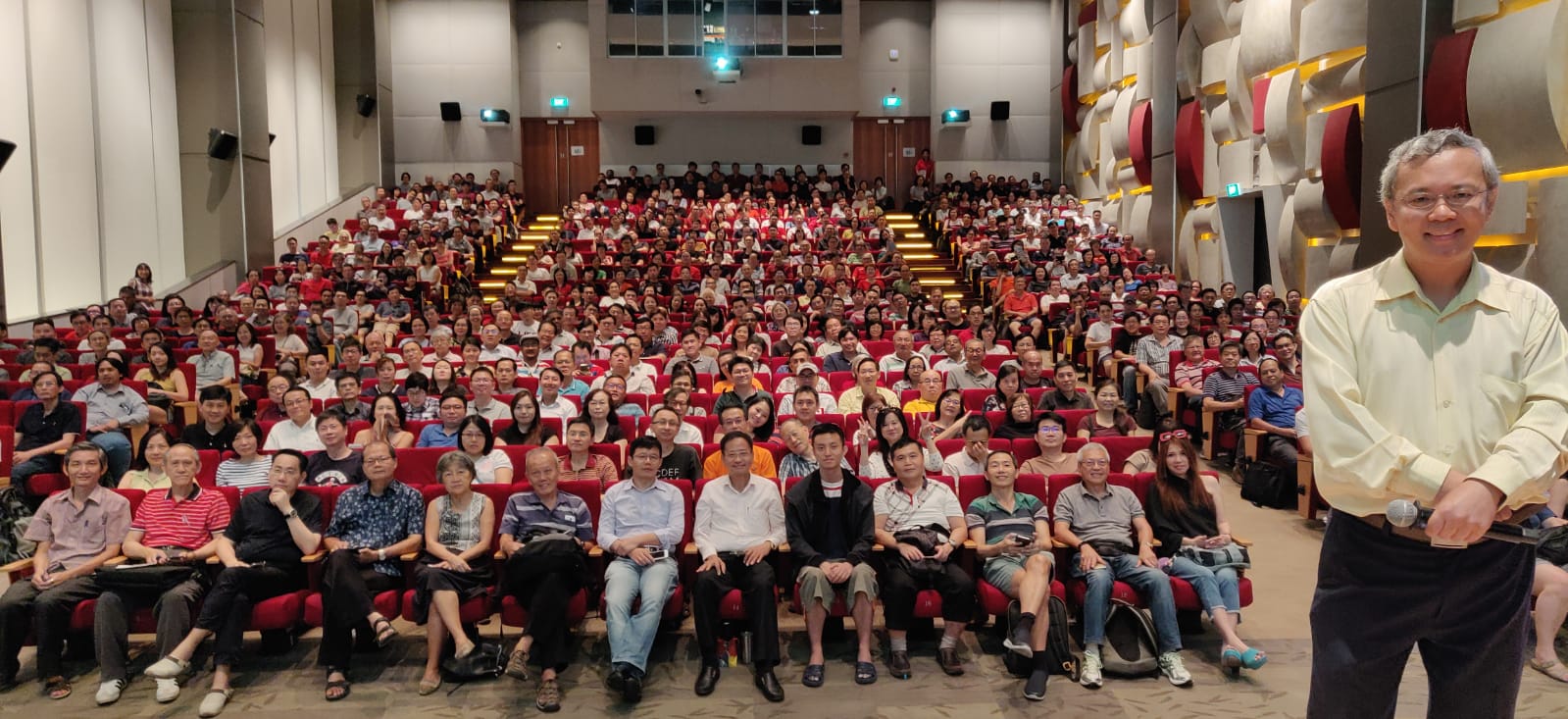
Thanks to overwhelming responses of Ein55 graduates, we just had the largest graduate gathering event today with 550 attendees, entire 550-seats auditorium is full (see group photo taken). I am touched to see a few late comers were even willing to sit on the floor, not to miss the learning.
 
Here are the 7 key learning points for sharing:
1) Year 2018 is a bearish global stock market, confirmed by the last bullish stock market, US (contributed to 50% value of global stocks), which has turned bearish for short term since Q4/2018.
 
2) There are 2 main possibilities: major correction or global financial crisis. Regardless of which outcome, mastery of 4 exit strategies are explained:
2.1) Exit when direction is wrong with risk tolerance reached
2.2) Exit with counter-trend strategies
2.3) Exit with follow-trend strategies
2.4) No Exit is required (only certain criteria allows so)
 
3) Stock investment is an integrated plan with 5 factors: LO-FTP, maximum of 5 stars for the best opportunity, minimum of 3 stars are required.
L = Levels 1-4 (alignment with smart money)
O = Optimism 0-100% (alignment with market emotions)
F = FA strength (alignment with business)
T = TA trends (alignment with prices)
P = Personal Actions (alignment with personality)
 
4) Defensive-growth-dividend giant stock is ideal dreamteam stock for long term investing during Levels 1-4 crisis. A few examples were given.
 
5) Decision making in stock is personality dependent. Long term investor may consider to buy at long term low optimism as contrarian investor while a short term trader may short at the same stock to make profits. Both could be correct actions. Do not blindly copy another expert’s best strategies, need to internalize them, forming own unique personalized investing.
 
6) 2 major actions are required: Spring Cleaning (if having stocks, following 5-steps processes given) and forming of Dreamteam Stocks (if do not have stocks).
 
7) Cash is King. A smart investor would not lock in the cash for over 1 year commitment (eg. long term bond of a few years). Crisis could become opportunity when cash is used at the right time in future with consideration of giant stocks and Levels 1-4 crisis.
 
General public may catch up with Global Stock Market Outlook 2019 by Dr Tee through free 4 hours investment course. Register Here: www.ein55.com

Dr Tee Investment Course (Stock, Property, Commodity, Forex, Bond)

Reduce Electricity Bill in Singapore with Investment Knowledge

Reduce Electricity Bill
Singapore has opened up electricity market to different service providers, starting from west, central / northeast (my area is just invited), will extend to east in next few months.
 
Electricity tariff (varying from 18 to 27 cents/kwh over the past 10+ years of market cycle) is partially related to natural gas price (remaining is fixed cost of power generation, so volatility amount may not be similar but general trends are aligned) which is connected to oil price. Current rate of 25 cents/kwh is still on high side, recent major correction (30% dip) of crude oil in Q4/2018 has not fully reflected in currently quarterly electricity tariff.
 
We may apply the principles of “trend-following”, consider shorter contract (eg. 6 months) while observing the trend of EE prices over the next 2 quarters since the prices are still at “high optimism”, may not worth it to lock in for 12 or 24 months. The partial relationship of oil price trend (now is weaker) and market cycle range (18 to 27 cents/kwh) may be used to position the “optimism” of current EE price.
 
Regardless which choice, it will be always cheaper than SP (Singapore Power) rates, so we should make the choice of new EE service provider ASAP when it is available in your area. With intense competition, it is hard for EE power generation company to make profits, one company has recently withdrawn from the market.
 
You may benchmark prices different EE companies here (enter size of house and average kwh used monthly). Comment below on your choice of company + package (fixed price or 23% discount over standard SP price), stating the reason of your choice.

Knowledge of investment (eg. commodity market: crude oil, etc) could be helpful in our daily lives, including reduction of electricity bill. You may sign up for free 4hr investment course by Dr Tee to learn about different investment markets: stock, property, commodity, bond and forex.
Dr Tee Investment Course (Stock, Property, Commodity, Forex, Bond)