Warren Buffett is also a Trader!

Ein55 Newsletter No 009 - image - BuffettMost people know that Warren Buffett is a value investor who usually buys stocks (eg. Coca Cola, >40% of the investment portfolio) and hold for a long term.  Few people know that sometimes Warren Buffett also “trades”, the annualized return (CAGR) can be even more impressive than his long-term-investing stocks.

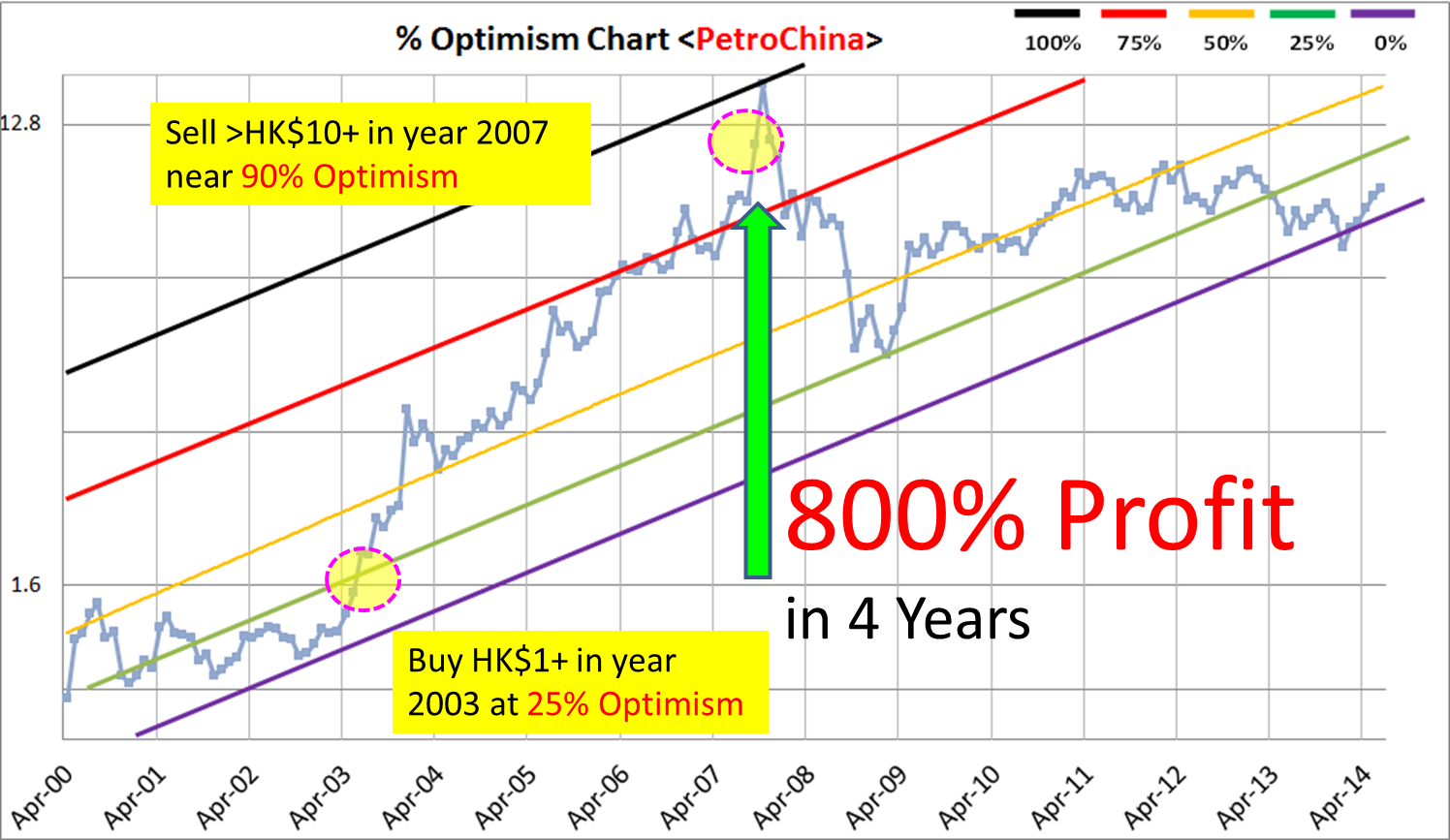
In the last market cycle, he decided to buy his first China stock (H-Share): Petro China in the year 2003 with an average price HK$1+ using about $500 Million capital.  In the year 2007, the market soared and he made a surprised move (against his style) to sell all the stocks of Petro China, above HK$12, taking 800% profit in 4 years, average of 200%/year return, perhaps his best “short” term record.

How he did it: knowing when to buy at very low and sell at very high?

Applying the Ein55 Optimism Chart (see figure below), we could notice that Warren Buffett actually entered around 25% Optimism while the price and optimism trend was up, existing around 90% Optimism (countered trend, his favorite investing style).  His famous saying is to be greedy when others are fearful, vice-versa. However, he did not teach his followers exactly when is considered fearful and greedy.  Some people may have to guess, when market are having a mid-term correction, they may think it is time to invest and hold for a long term.  However, when the true global financial crisis comes, the past earning will be completely wiped out, value investing or long term investing could make a loss if timing of entry is not a low enough position.

Ein55 Optimism Chart is a solution, one could know when is truly low (eg <25% Optimism), when is truly high (eg >75% Optimism), not limited to stocks, but also applicable for any investment involving human (eg. Property Market, Bond Market, Commodity Market, Forex, Bank deposit, etc) because human’s weakness in emotional control resulting in most people tend to buy high sell low: following others to buy together during the last rally, then again to sell together near to the end of the crisis.  A trader and an investor’s biggest enemy are themselves, not the market. One has to overcome one’s mind to be a successful trader or investor.

At the highest level, the difference between trading and investing is only a fine line.  The “secret” of making money in any investment is always BUY LOW SELL HIGH.  It is easy but how many people could fully follow this belief?  Warren Buffett was considered a trader because he only used 1% of his capital or wealth ($0.5B out of $60B) to buy Petro China.  He bought when the trend was up (trend rider), taking profit when the profit target is reached.  Warren Buffett actually integrates trading techniques into investing, translating into Market Cycle Investing which usually gives higher return than value investing (following economy cycles to buy low sell high) but a more predictable outcome than trading.

Many people argued whether trading (eg from day trader to a few months of trading) or investing (eg period of a few years or even permanently) is a preferred choice to make money from stock market.  In my opinion, results of both methods are comparable if one could be the best trader or the best investor.  The key of success is to align the trading plan or investing strategy with own’s personality (eg. risk tolerance level, target for profit, amount of free time, emotion control, etc).  Many people simply pursue the best methods of other trading experts or investing masters, trying to duplicate the key of success.  They could be disappointed if the missing link is not awared.

Whenever I conduct trading/investing courses, I would conduct an investing profile analysis of my students, knowing their past trading / investing behaviors.  This is like a doctor must understand a patient’s medical history before recommending the best medication, which usually must match the patient’s health condition.

Ein55 Optimism method could successfully integrate short/mid-term trading and long term investing under one roof with consideration of Fundamental Analysis (both individual stock and macroconomy), Technical Analysis and Personal Analysis.  A trader or an investor will know which hat (trading or investing) to wear, depending on the Optimism level of the market, so that one could fully utilize their strength.

Back to Petro China, the regret was that we can only watch Warren Buffett making big money from the market in 2003-2007.  The good news here is that the low optimism level is finally back for Petro China.  It is now at 7% Optimism with uptrend.  The “parent” of this stock, China SSEC is now at 26% Optimism, a very attractive low level to buy A50 (through A50 ETF in Singapore or Hong Kong) or related H-Shares and S-Chips, many stocks are at low optimism,  some with very good fundamentals and a few with strong uptrend.  I prefer to apply multi-perspective methods through Ein55 Styles to maximize the profit with low risk.

A stock with strong FA, low optimism, uptrend TA and positive PA is hard to find, but when the opportunity comes, one has to be prepared to grab it: knowing what to buy, when to buy/sell, how much to buy/sell, how to react for different market conditions.  One may not have to chase after a bullish market to make money. We may earn much more from a bearish or sideway market, if the right strategy is applied.

Ein55 Newsletter No 009 - image - warren buffet is also a trader

Light at the End of Tunnel – SMRT

Ein55 Newsletter No 007 - image - light at the end of tunnelDue to busy schedule, it has been some time since I last updated the blog.  STI has become bullish in the past few months, now 50-day moving average is above 200-day moving average, a long-term bullish indicator for TA believer.  In investing, there is no need to watch the market everyday or even every week.  We just have to position ourselves ahead of others and wait patiently.

When I conducted the Ein55 course in Feb 2014, my graduates applied the market optimism strategy, informing me there is a good opportunity to buy SMRT at 0% Optimism.  There are 800+ stocks in Singapore and numerous in the world stock markets, therefore usually my students are the ones who gave me the “stock tips” (not the other way round as they have learned to fish, no need for me to give fish to them) using the Ein55 Styles learned.  I analyzed SMRT and posted on 20 Feb 2014 in blog:

https://www.ein55.com/2014/02/stock-screening-by-ein55-optimism-method-smrt/

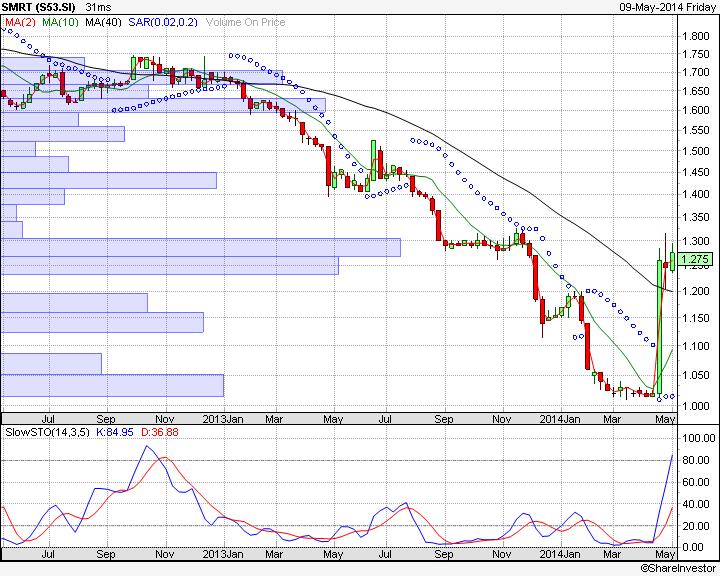
Buying low-optimism stocks at undervalue, one must also compare price vs value to ensure price is much lower compared to its value.  There is also a winter period to endure because usually these low-optimism stocks will not recover in price in short term.  For SMRT, it took about 2 months (considered short as it was at 0% Optimism) for its winter, last few weeks have been its spring time, having 30% rally since the last post in blog (price was $1.03 then).  If 30% profit is considered great, then market optimism strategy is under-estimated because this method aims for average of 50 – 200% return.  Buying SMRT at 0% Optimism, the maximum potential return could be as high as 200% but it depends on the personality of individual, some may want to take profit after 20-30% return, some could wait till 100% return, but may be only a few have the patience or courage to wait for 200% return.

Some may feel the rally of SMRT and some stocks are due to speculation.  This is possible.  However, we should understand why they are speculated and not other stocks?  An undervalued stocks with low optimism, when the price was over-corrected in the past, naturally it becomes the star when there is a positive good news in future.  Sometimes we may not know how long will be the winter period to wait but we just position ourselves when majority of others are not interested.  This is only an early spring for SMRT, price could drop to wipe out those trend riders who buy high and hope to sell higher.

There are many more low-optimism stocks discovered by my graduates.  The choice will require matching in individual personality.  For example, buying NOL at $1 when FA or earning is declining for many quarters.  The price could drop below $1 (it did) but when the shipping industry has fully recovered, NOL records the first positive earning of the quarter in near future, then you could expect similar “speculation” in price again.  Do you prefer to buy something at discount during Great Singapore Sales or bid for higher price in a tender?  This is your choice, one has to overcome one’s mind, before can be successful in trading or investing.

Ein55 Newsletter No 007 - image - SMRT

Stock Screening by Ein55 % Optimism Method – SMRT

Ein55 Newsletter No 004 - image - SMRTSorry for missing the last weekly article because I was too busy with the preparation of Feb 2014 class (4-day course) which requires my full focus and attention.  Similar to the previous classes, I try to impart 17 years of my investing experience within 4 days, could be overwhelming for some students, especially when they went through the Day1 evening class till 10:45pm, then Day2 class from 8am+ to 8pm+ without giving in to tiredness.

I am very touched to see their strong spirit of learning, willing to sacrifice the next few days to complete the homework assigned (the knowledge can only be retained and become yours with own practice).  One of the tasks is stock screening (what to buy) to identify stocks which could potentially give 50-200% return in future, applying the Ein55 % Optimism method.  Other than NOL ($1) and China SSEC ETF (2000 points) with low optimism which I shared in the earlier articles, they have learned to apply and spot many other good investing opportunities.

One of the cases studied by the students is SMRT.  Based on the preliminary FTP (FA + TA +PA) Analysis: Technical Analysis, TA (see chart below), trend in the last few years has been bearish (shorter moving average (MA) is below longer MA; parabolic SAR as resistance), partly due to weak Fundamental Analysis, FA (eg. higher cost of MRT repair, declining earning per share (EPS) and higher price-earning ratio (PE)) and negative Personal Analysis, PA (eg. cases of MRT breakdown, losing public confidence).  Logically, most people would think SMRT is bearish, therefore not a good buy now.

For trend followers (traders / investors), they may apply MA, eg. when 50 day (about 2 months) MA is above 200 day (about 9 months) MA to enter in year 2012 (around $1.70/share, after prices came down from the peak of $2.30/share with about 30% discount) but then quickly cut loss when the signal changed to sell in a few months, dropping another 30% of the price till now (nearly $1/share). Most people would stay away from SMRT as they would not know how low it may go down further (eg. another 30%), probably below $1 as the historical low was around $0.50 in year 2003 during SARS crisis.  Likely they would wait for the mega trend to reverse, eg. 50 day MA is above 200 day MA, before considering SMRT again.  Some may not consider SMRT at all.

If one applies conventional support and resistance TA method, price of $1 is only a secondary support (similar to years 2005-2006) and $0.50 is the mega support, so the longer-term buying signal may not there yet using this strategy.  Following Ein55 % Optimism principle, current price (nearly $1) of SMRT is just below 0% Optimism, implying a very good opportunity to buy low and sell high in future.  For investor with holding power of a few years, buying at this price will have very high probability of >50% gain.  Knowing what to buy does not mean one has to buy immediately (when to buy).  There are several strategies available for timing of buy and sell, as well as how much to buy and sell.

For counter-trend method, now is a good timing (buying around $1) but one has to prepare to endure a possible period of short winter time (price may come down further but potential of “falling knife” is limited due to low optimism), while SMRT improves on its FA (eg. better EPS in 2014 compared with 2013), this will help to attract longer-term investors, then supported by speculation of short-term traders when there is a V-shape rebound in near future, especially when STI is moving upward.  If one could not afford to lose money, even for a short period of time, then follow the trend to buy is recommended, however, a premium of >20% higher stock price may be required to confirm its longer-term trend reversal.  Trend follower seems safer but the entry could be at its mid-term high and one with weak holding power may not able to hold through 10% price correction later due to market volatility, either will cut loss or make little profit.  A combination of counter-trend and follow-trend method is possible, one may use shorter pair of MA (eg. 20/50 days MA using mid-term trading method) to buy SMRT now, minimizing the short-term downtrend risk, enable buying at relatively low point.  The selling will be considered after >75% Optimism in future.

The % Optimism method will have much higher chances of success when combining with detailed FTP (FA + TA + PA) Analysis, considering both the individual stock and mega stock market and economy trends (sector, country, region, world).  The holding power with knowledge of mega trend will minimize its long-term risk.  Knowing what to buy is useful but the next step will be when and how much to buy and the ultimate results depend on when and how much to sell.  Many investors know what stocks to buy (eg. blue chips with strong FA, hearing from stock tips shared by analysts) but still could lose money easily due to lack of personalized investing strategy.

Control of greed and fear is critical to maximizing the profit >50% (not only to gain / lose a few %), this can be guided by % Optimism of individual stock and also the mega market (eg. STI or major regional indices).


Stumbling Year of Horse – A Blessing in Disguise

Newletter-003 - HorseOver 20% of the world populations are celebrating lunar new year of Horse 2014 but the “Wooden Horse” stumbled on the first trading day of global stock market, against the best wishes of traders to have a leading horse up the hill of bull market.  This poor opening could be a disappointment to most stock traders and investors.  However, for those who attended my earlier Global Market Outlook Workshops, they will understand that this is actually a blessing in disguise.

With the accelerated recovery of world economy, most regional stock markets have good performances in stock market in year 2013, except Singapore market (STI) continues to sleep, having virtually no change in position.  The main mid-term risk of global investment market is US stock market which has climbed up the hill of bull market (reaching about 60% Optimism, a leading stock market) without a good rest of 10% or more correction, even after the announcement of the first QE3 tapering.  US stock market requires a correction, so that the global stock market has the energy to go up further in phases of bull market.  The recent second announcement of QE3 tapering (reducing QE from $75B to $65B) and slow recovery of emerging market (eg. China), giving a good excuse for some global stock traders to take the profit and wait for the next buying opportunity, leading to the overdue correction.

Even the stagnant Singapore stock market is affected, STI falls below 3000 points (ending 2990 points on 3 Feb 2014) for the first time since Nov 2012.  This is also the 6th time in the last 4 years for STI to go above and then below the 3000 points of psychological barrier during a mid-term cycle (usually a few months of duration).  On 20 May 2013, STI was at mid-term high of 3454 points, there were traders who hoped to buy high and sell higher, especially for property related stocks.  Since then, STI has been corrected by about 13% and REITS sector index is down by about 20%.  Many people prefer to wait and see during this period, staying sideline, not taking any new action.

Some workshop participants asked me in the past few months whether it is a good time to enter the stock market.  The question I asked in return was: “Do you feel scared?”.  In fact, most people don’t feel fearful nor greedy in the past 1 year, aligning well with the sideway trend of STI.  If you are not scared, then it is not a reasonably good time to enter the stock market.  If not only you are fearful but over 75% stock traders or investors are pessimistic, then it could be a golden opportunity to enter the market.  Although STI and many regional stock markets are near to 50% Optimism, upside is about the same as downside, but there are still individual stocks, sectors and even regions which are trading near to or below 25% Optimism with 3 times upside more than downside.

NOL today (3 Feb 2014) is exactly at $1.00/share, meeting my earlier recommendation to buy, this is the second time it has reached $1 since the global financial crisis in 2009, last dip was Nov 2011.  Although NOL has poor FA, its poorer price has compensated for the weakness.  Similar recommendation was to buy China SSEC Index related ETF when the index is at or below 2000 points, which happened for the 3rd time about 2 weeks ago.  There are also other fundamentally-strong stocks which are trading at low Optimism level.  One who follows this simple strategy of buy-very-low sell-very-high, may not see these stocks to go uptrend immediately after buying at such low price.  Instead, likely they have to endure a relatively short period of winter time before the spring time may come.  STI or related blue chips, are considered reasonable good buy when STI is trading below the 50% average line (3000 points) of the index channel of 2700 – 3300 points, lower is better, depending on one’s patience and market opportunity.

Buy at very low will enable us to maximize the profit in longer term but one has to control the emotion of fearful market.  Following the trend is a common trading method used by traders but one has to be the top 10% best traders or at least the lucky ones to enter during the initial phase of the uptrend, else the future upside will be limited when the uptrend is confirmed, eg. when STI is above 3300 points, susceptible to the next market correction.  A stock trader or investor has to make the decision whether the ultimate goal is just to win (regardless of % gain) or to maximize the profit (may not immediate, having holding power of over 1 year), then aligning the trading or investing strategy accordingly.